
Rooming House vs Co-Living vs Boarding House
In short
In Victoria, 'rooming house' is the legal term for a building where rooms are rented and four or more people in total can live, usually sharing facilities. 'Boarding house' is the everyday word, and a legal category in some other states. 'Co-living' is what the market calls modern shared housing, and in Victoria it's regulated as a rooming house.
Key takeaways
- 'Rooming house' is the term Victorian law uses, and it's the one that decides which rules apply. The test in the Residential Tenancies Act 1997 is capacity, not the name on the sign.
- 'Boarding house' is an older, everyday word in Victoria. It doesn't appear anywhere in the state's tenancy, public health or building laws, but it's a legal category in New South Wales and a building type in the National Construction Code.
- 'Co-living' is a style and a way of marketing shared housing. It isn't a legal category in Victoria, and a co-living home where four or more people rent rooms is a rooming house in law.
- The building class, such as Class 1b under the National Construction Code, is a separate question from the label. Planning, building and tenancy law are three layers on the same building.
- Whatever it's called, a Victorian rooming house has to be registered with the council, run by a licensed operator and meet the state's minimum standards.
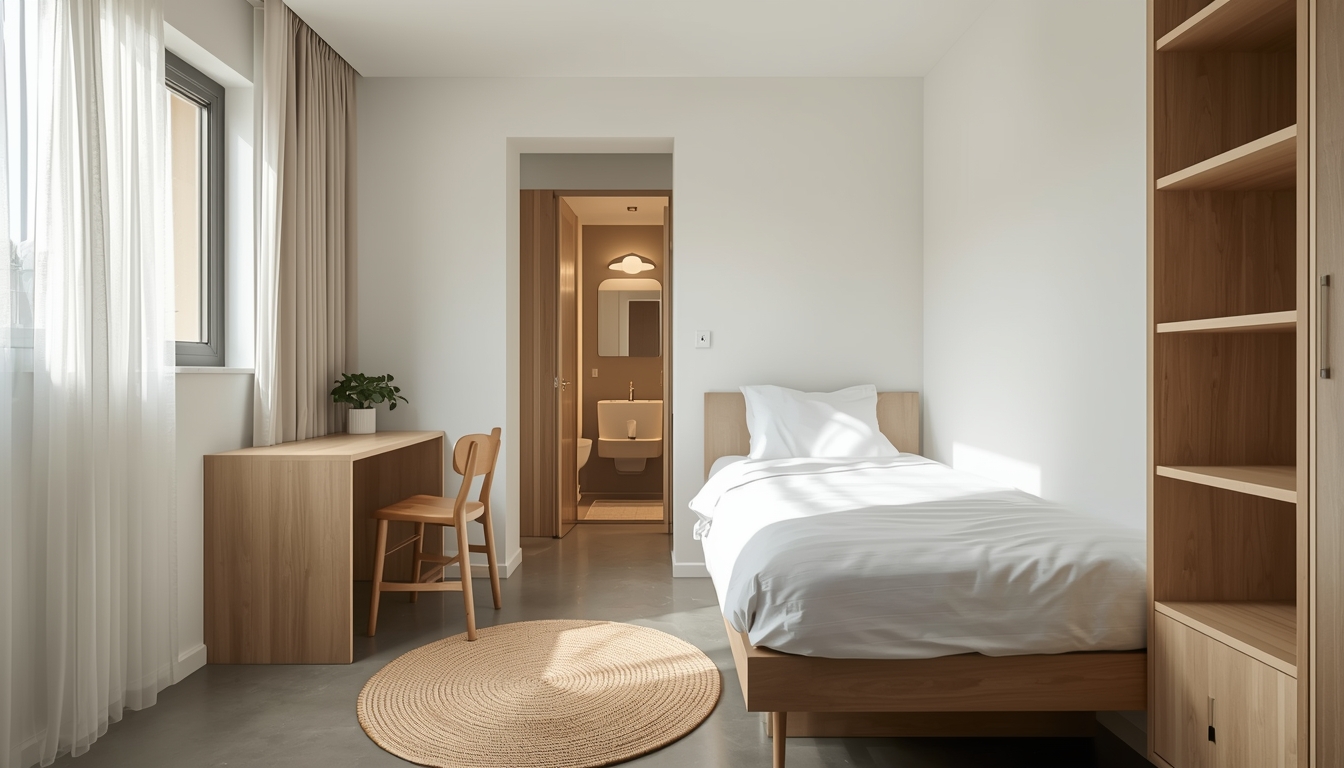
Three words get used for the same building, and only one of them is in the Victorian statute book. "Rooming house" is the term the law uses. "Boarding house" is what most people's grandparents called it. "Co-living" is what the brochure says now. People use them as if they were interchangeable, and in conversation they more or less are. The moment a council, a building surveyor or Consumer Affairs Victoria gets involved, they aren't.
This guide puts the three terms side by side: where each one comes from, who uses it, and which one carries legal weight in Victoria. It also answers the two questions that come up every time. Is a share house a rooming house? And what building class does a rooming house or co-living home fall into? The rules themselves are in the guide to rooming house rules and minimum standards in Victoria, and the building classification is in the guide to Class 1b rooming houses, so this one doesn't repeat them in full.
What is a rooming house in Victoria?
A rooming house is the legal term in Victoria for a building where one or more rooms are rented out and four or more people in total can occupy them. Residents usually have their own room and share facilities such as kitchens, bathrooms or laundries.
The definition sits in section 3 of the Residential Tenancies Act 1997. A rooming house is a building, other than a specialist disability accommodation dwelling, "in which there is one or more rooms available for occupancy on payment of rent" and "in which the total number of people who may occupy those rooms is not less than 4". The test is capacity. It doesn't matter how many people are home tonight, or how many rooms there are. If four or more people may occupy the rented rooms, it's a rooming house.
Sharing comes in through the Act's definition of a "room". That's a room occupied as a residence by a person who has a right to occupy it "together with a right to use in common with others any facilities in the building", and not a self-contained apartment. A resident's right to the room is exclusive unless the operator gave written notice before move-in that it's a shared room. In that case the operator can choose who else lives in it. Consumer Affairs Victoria puts the whole thing plainly: "A rooming house is a building where one or more rooms are available to rent and four or more people in total can occupy those rooms." Under section 19 the Minister for Housing can also declare a smaller building to be a rooming house, though that's rare.
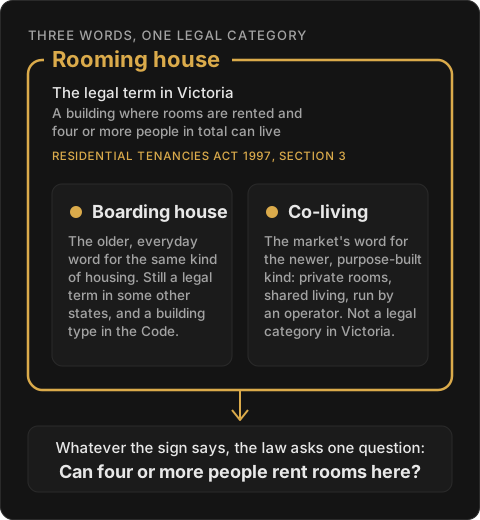
The law doesn't ask what the building is called. It asks whether four or more people can rent rooms in it.
Because the term carries legal weight, a lot follows from it. Residents get their own set of rights under the Act: a written statement of those rights, the house rules, notice before the operator enters, and a room and shared facilities that meet the Residential Tenancies (Rooming House Standards) Regulations 2023. The building has to be registered with the local council as prescribed accommodation under the Public Health and Wellbeing Act 2008, and whoever runs it needs a licence from the Business Licensing Authority under the Rooming House Operators Act 2016. The rooming house rules guide sets all of that out.
Rooming houses come in every age and shape. Some are large older homes converted room by room decades ago. Others are new and purpose-built, with an ensuite behind every bedroom door. The law treats them all the same.
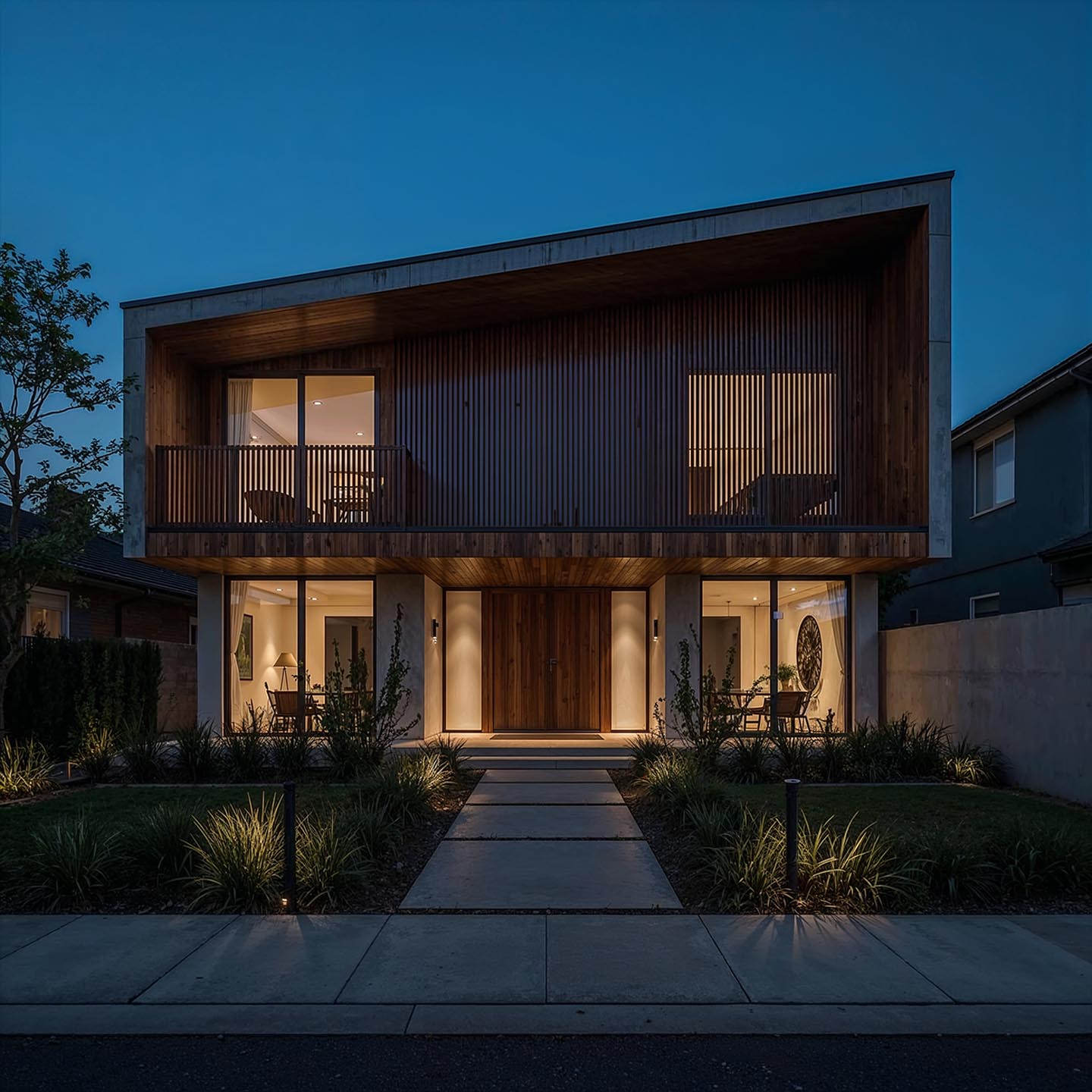
A new purpose-built rooming house. In Victorian law it's in the same category as a converted Edwardian home with nine rooms, and the same rules apply.
What is a boarding house, and is it different from a rooming house?
In Victoria, "boarding house" is mostly an everyday or older term for the same kind of housing. A boarding house that meets the rooming house definition is regulated as a rooming house. In some other states, "boarding house" is the formal legal category.
The word is older than the law. Historically a boarding house was a home where a landlord or landlady let rooms, often with meals included and a proprietor living on the premises. That shade of meaning survives where the term is still defined. The Australian Capital Territory's Territory Plan, for instance, describes a boarding house as a principal place of residence "where meals, laundry or other services are provided" to residents, with or without shared facilities.
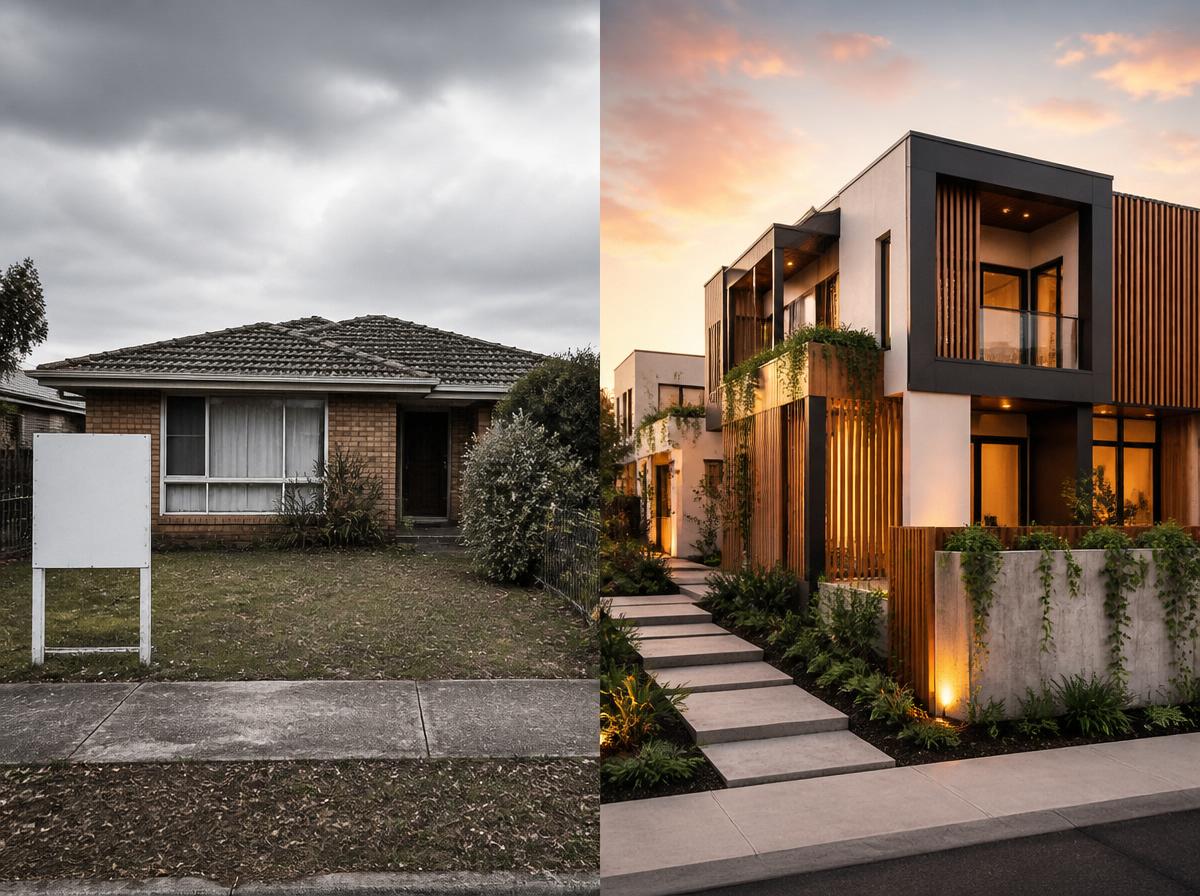
Old stock and new. Both can be rooming houses in Victorian law. Only the one on the left would ever have been called a boarding house.
In Victoria the legal test turns on the rooming house definition, not the name. You won't find the phrase "boarding house" anywhere in the Residential Tenancies Act 1997, the Public Health and Wellbeing Act 2008, the Rooming House Operators Act 2016, the Building Act 1993 or the Building Regulations 2018, or in the regulations that set the rooming house standards and the prescribed accommodation rules. Consumer Affairs Victoria's own renter pages use it only in passing. They say a rooming house "is different to a share house, boarding house or sub-let", which tells you how loosely the word floats around. If a building people call a boarding house has rooms for rent and four or more people can live in them, it's a rooming house and every rooming house rule applies.
Cross the border and the picture changes. New South Wales has a Boarding Houses Act 2012, and NSW Fair Trading keeps a public register of "registrable boarding houses": general boarding houses with five or more paying residents, and assisted boarding houses for people with additional needs. Queensland uses yet another term, "rooming accommodation", in its Residential Tenancies and Rooming Accommodation Act 2008. It's defined as accommodation where each resident has a right to occupy one or more rooms but not the whole premises, and shares facilities with other residents. So the same building is a rooming house in Melbourne, a boarding house in Sydney and rooming accommodation in Brisbane.
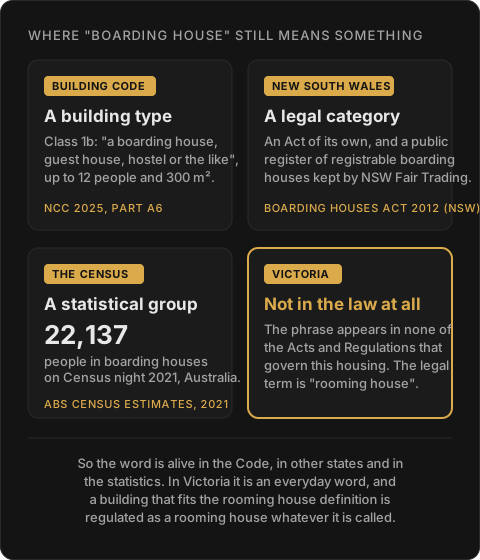
The word hasn't gone anywhere. It just isn't the one Victorian law uses.
Two more places keep the term alive. The National Construction Code describes Class 1b as "a boarding house, guest house, hostel or the like" for up to 12 people and 300 square metres, and lists boarding houses again among Class 3 buildings. That's a building classification. It decides how a building is constructed, and it isn't a tenancy label. Victoria's Building Regulations 2018 pick up the class numbers rather than the words. And the Australian Bureau of Statistics still counts "people living in boarding houses" as one of its six homelessness groups: 22,137 of them on Census night 2021. The Census itself also lists "boarding house, private hotel" as a category of non-private dwelling.
What does co-living mean?
Co-living is a market term for shared housing where residents rent a private room or studio and share common spaces, usually in newer or purpose-built buildings. In Victoria it isn't a separate legal category, so a co-living property that meets the rooming house definition is regulated as one.
The typical features are easy to picture. Private rooms, often with their own ensuite and sometimes a kitchenette. A shared kitchen, living and dining area, and a laundry. Rooms let furnished, usually on individual agreements, with bills handled by an operator who manages the building. The word signals a design and a resident experience that's different from the older rooming houses most people have in mind, and that's exactly why operators use it.
The label doesn't change the legal obligations. If four or more people can rent rooms in the building, Victorian law calls it a rooming house. It has to be registered with the council, the operator has to be licensed, and every room and shared facility has to meet the rooming house standards. Calling it co-living doesn't lift any of that, and it doesn't add a separate rulebook either.
That's the Victorian position, and it isn't the same everywhere. As at October 2026 the term "co-living" doesn't appear in Victorian legislation, in the land use terms of the Victoria Planning Provisions, or on the rooming house pages of Consumer Affairs Victoria. New South Wales, by contrast, made "co-living housing" a defined land use in its Housing State Environmental Planning Policy in November 2021: a building with at least six private rooms, shared facilities, and a manager contactable around the clock. South Australia added co-living as a land use term in its planning code in October 2025. In Victoria the planning scheme simply says a rooming house is "land used for a rooming house as defined in the Residential Tenancies Act 1997", and that covers the co-living building too.
How do rooming houses, co-living and boarding houses compare?
The three terms often describe similar housing, but only "rooming house" is the legal category in Victoria. The practical differences are in who uses each term, the age and design of the buildings and how they're marketed.
| Rooming house | Co-living | Boarding house | |
|---|---|---|---|
| Legal status in Victoria | The defined term in the Residential Tenancies Act 1997 and the term every Victorian regulator uses | Not a legal term. A co-living building that fits the definition is a rooming house | Not a legal term. A boarding house that fits the definition is a rooming house |
| Where the term is used | Victorian law, councils, Consumer Affairs Victoria, the planning scheme | Developers, operators and the property market, here and overseas. A planning term in New South Wales and South Australia | Everyday speech, older buildings, the National Construction Code, New South Wales law, the Census |
| Typical building | Any: a converted older home or a new purpose-built building | Newer or purpose-built, designed around private rooms and shared living | Traditionally an older large house, sometimes with meals or a resident proprietor |
| Typical resident arrangement | Each resident rents a room, exclusive or shared, with a right to use the common facilities | A private room, often with an ensuite, on an individual agreement, managed by an operator | Historically a room with board; today, whatever the building actually offers |
| Which Victorian rules apply | Council registration, a licensed operator, the rooming house minimum standards, residents' rights under the Act | The rooming house rules, if four or more people can rent rooms | The rooming house rules, if four or more people can rent rooms |
So in Victoria, "rooming house" is the legal term, "boarding house" is the older everyday term, and "co-living" is the marketing term. A building that fits the Residential Tenancies Act definition is a rooming house whichever word is on the sign, and the registration, licensing and minimum standards follow from that. Building class is a separate question, and the National Construction Code answers it. You'll find more co-living and rooming house guides in the resource hub.
Is a share house a rooming house?
Not usually. A share house where housemates rent the whole property together is generally a standard residential tenancy, while a property where rooms are rented separately to four or more people in total can meet the rooming house definition.
The difference is in the deal, not the floor plan. In a share house, the household holds one residential rental agreement for the whole property and shares possession of all of it. Consumer Affairs Victoria calls that co-renting: "several people rent a property together, such as in a share house." Each housemate is a renter of the whole house, and the ordinary rental rules apply. In a rooming house, each resident has their own right to a room, exclusive or shared, plus the right to use the common facilities, and the operator decides who lives in the other rooms.
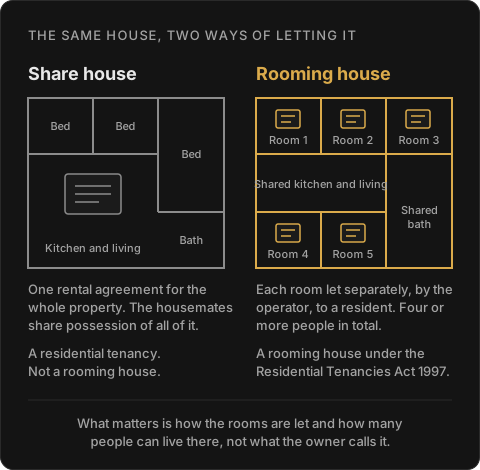
Same house, two ways of letting it. Only the one on the right is a rooming house.
What matters is how the rooms are let and how many people can live there, not what the owner calls the arrangement. An owner who lets five rooms individually in a suburban house is running a rooming house whether or not anyone ever uses the word, and the registration, licensing and standards obligations come with it. The reverse holds too: four friends on one lease aren't a rooming house just because there are four of them.
This is general information. If you're trying to work out which side of the line your own situation falls on, Consumer Affairs Victoria is the place to ask.
What building class applies to rooming houses and co-living in Victoria?
Smaller rooming houses are typically classified as Class 1b buildings under the National Construction Code, while larger ones fall into Class 3. The building class sets the construction and fire safety requirements, and it's separate from the tenancy rules.
The Code describes Class 1b as a boarding house, guest house, hostel or the like that would ordinarily accommodate not more than 12 people and has a total floor area not more than 300 square metres. Go over either limit and the building is generally Class 3. The Code defines that as a residential building providing long-term or transient accommodation for a number of unrelated persons, and it's designed under Volume One, the rulebook for larger buildings. In Victoria the Code takes effect through the Building Act 1993 and the Building Regulations 2018. The regulator is the Building and Plumbing Commission, the Victorian Building Authority under its current name, and the current edition, NCC 2025, has applied since 1 May 2026. The Class 1b guide covers the classification in full, including why converting a house into a rooming house is a change of class that needs a building permit and an occupancy permit.
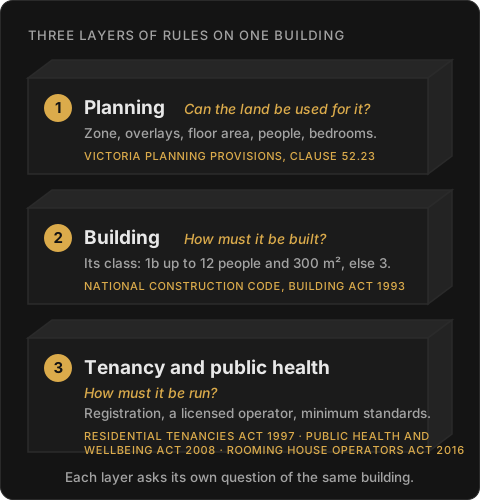
Three questions, three bodies of law. A rooming house has to pass all three, and the label on the brochure doesn't answer any of them.
It helps to see building class as one of three layers of regulation that each ask a different question of the same building. Planning asks whether the land can be used for it. Clause 52.23 of the Victoria Planning Provisions lets a rooming house of up to 300 square metres, 12 people and 9 bedrooms go ahead without a planning permit for the use in the main residential zones, subject to the zone's conditions and any overlay. Building asks how it has to be built: its class under the Code, and the permits that follow. Tenancy and public health law ask how it has to be run: registration, the operator's licence, the minimum standards and residents' rights. "Rooming house" is the term in the third layer. "Class 1b" is the term in the second. They describe the same building from two directions, and a small purpose-built co-living home in Victoria is almost always both.
Why does the terminology matter?
The term used affects which rules apply, what residents can expect and how a property is assessed. For residents, owners, developers and lenders, checking whether a property legally is a rooming house matters more than what it's called.
If you're a resident, the legal category decides the rights that come with your room: the statement of rights, the house rules, notice before entry, the standards the room and the shared facilities have to meet, and where to go when they don't. A co-living operator's brochure can promise more than the standards require, but the standards are the floor, and they apply because the building is a rooming house.
If you own or operate one, the category brings obligations whether or not you planned for them: registration with the council before residents move in, a licence for whoever runs the house, and ongoing duties around safety checks and repairs. Calling the building something else doesn't move it out of the category. Councils and Consumer Affairs Victoria both act against operators who run a house unregistered or unlicensed.
For a developer or a lender, the three layers shape what a project is and what it costs. The building class decides the construction and fire-safety standard. The planning position decides whether a permit is needed. The tenancy and public health rules decide what the finished building has to contain before it can open. A site that works as a nine-room Class 1b rooming house may not work as a fourteen-room Class 3 building, and the difference is the rulebook, not the name. The regulatory side is one of the risks set out in understanding risk in small-scale development. If you're weighing a project or the lending side of one, the co-living investor FAQ covers the questions that usually come next.
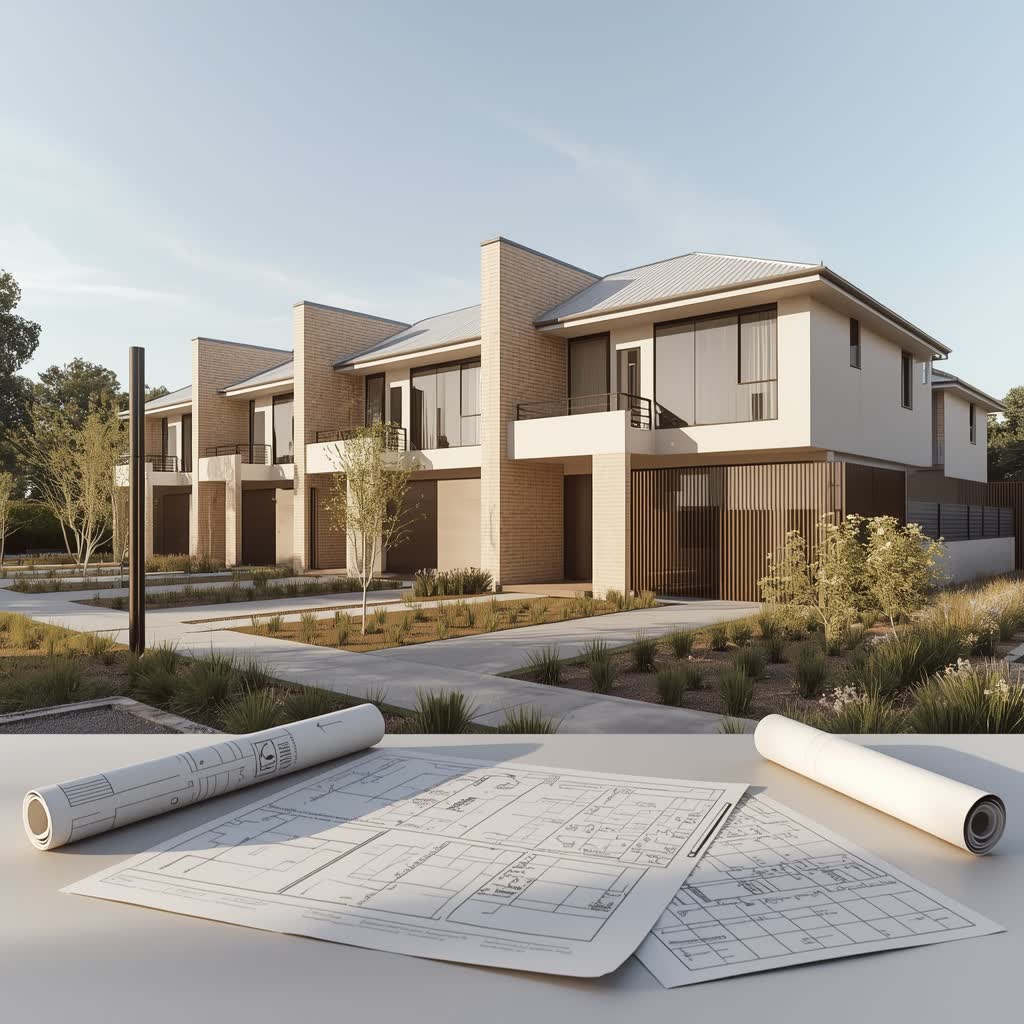
New rooming houses are designed to all three layers from the first drawing. The name they're marketed under comes last.
At EME, I develop new Class 1b rooming houses in regional Victoria. We describe them as co-living because that's what they are to the people who live in them: a private room with an ensuite and kitchenette, shared living spaces, a managed building. To the council, the building surveyor and Consumer Affairs Victoria they're rooming houses, and I design every one from the start to that definition and the standards that come with it. Getting the terminology straight is the first step to getting the approvals, the compliance and the budget right. It's where I start every conversation about a new site. You'll find my background and the projects behind it on my profile page, and if you'd like to talk a project through, you can book an introductory call from the homepage.
Sources
- Victorian Legislation, Residential Tenancies Act 1997
- Victorian Legislation, Residential Tenancies (Rooming House Standards) Regulations 2023
- Victorian Legislation, Public Health and Wellbeing Act 2008
- Victorian Legislation, Public Health and Wellbeing (Prescribed Accommodation) Regulations 2020
- Victorian Legislation, Rooming House Operators Act 2016
- Victorian Legislation, Building Act 1993
- Victorian Legislation, Building Regulations 2018
- Consumer Affairs Victoria, Rooming house operators: definitions
- Consumer Affairs Victoria, Report your rooming house concerns
- Consumer Affairs Victoria, Sharing in a rooming house
- Consumer Affairs Victoria, Co-renting: renting with other people
- Consumer Affairs Victoria, Rooming house operators licensing scheme
- Department of Health (Victoria), Public Health and Wellbeing (Prescribed Accommodation) Regulations 2020
- Australian Building Codes Board, National Construction Code 2025, Volume Two, Part A6 Building classification
- Department of Transport and Planning (Victoria), Victoria Planning Provisions, Clause 52.23 Rooming house
- Department of Transport and Planning (Victoria), Victoria Planning Provisions, Clause 73.03 Land use terms
- NSW Government, Boarding houses
- NSW Department of Planning, Housing and Infrastructure, Boarding houses and co-living
- Queensland Legislation, Residential Tenancies and Rooming Accommodation Act 2008
- ACT Legislation Register, Territory Plan 2023, Dictionary
- Government of South Australia, Accommodation Diversity Code Amendment: first stage adopted
- Australian Bureau of Statistics, Estimating Homelessness: Census, 2021
- Australian Bureau of Statistics, Census Dictionary 2021, Type of non-private dwelling
Common questions
Do rooming houses in Victoria have to be registered?
Yes. A rooming house is prescribed accommodation under the Public Health and Wellbeing Act 2008, and section 67 says the proprietor must register it with the council for the district it sits in. Whoever runs it as a business also needs a licence from the Business Licensing Authority under the Rooming House Operators Act 2016. Registration follows the building and the licence follows the operator. A rooming house needs both.
Do rooming house residents have the same rights as other renters?
Not the same, but they're comparable. The Residential Tenancies Act 1997 has a part of its own for rooming houses. Residents get a written statement of their rights, the house rules, notice before the operator enters, a repairs process and a room that meets the Residential Tenancies (Rooming House Standards) Regulations 2023, rather than the general rental minimum standards. The rooming house rules guide has the detail.
Is a rooming house the same as a hostel or backpackers?
Not usually. The National Construction Code can put either one in Class 1b or Class 3. Victorian law is where they part ways: a rooming house resident occupies a room as their only or main residence, while a hostel or backpackers usually takes guests for short stays. The Public Health and Wellbeing (Prescribed Accommodation) Regulations 2020 list hostels and rooming houses as separate classes of accommodation that councils register.
Can a co-living property have more than 12 residents?
Yes. In Victoria it's still a rooming house, with the same registration, licensing and standards. What changes is the building side. Above 12 residents or 300 square metres it's no longer Class 1b under the National Construction Code. It's generally Class 3 and built to Volume One. The planning exemption in clause 52.23 stops applying too, so the use generally needs a planning permit, depending on the zone.
Related reading
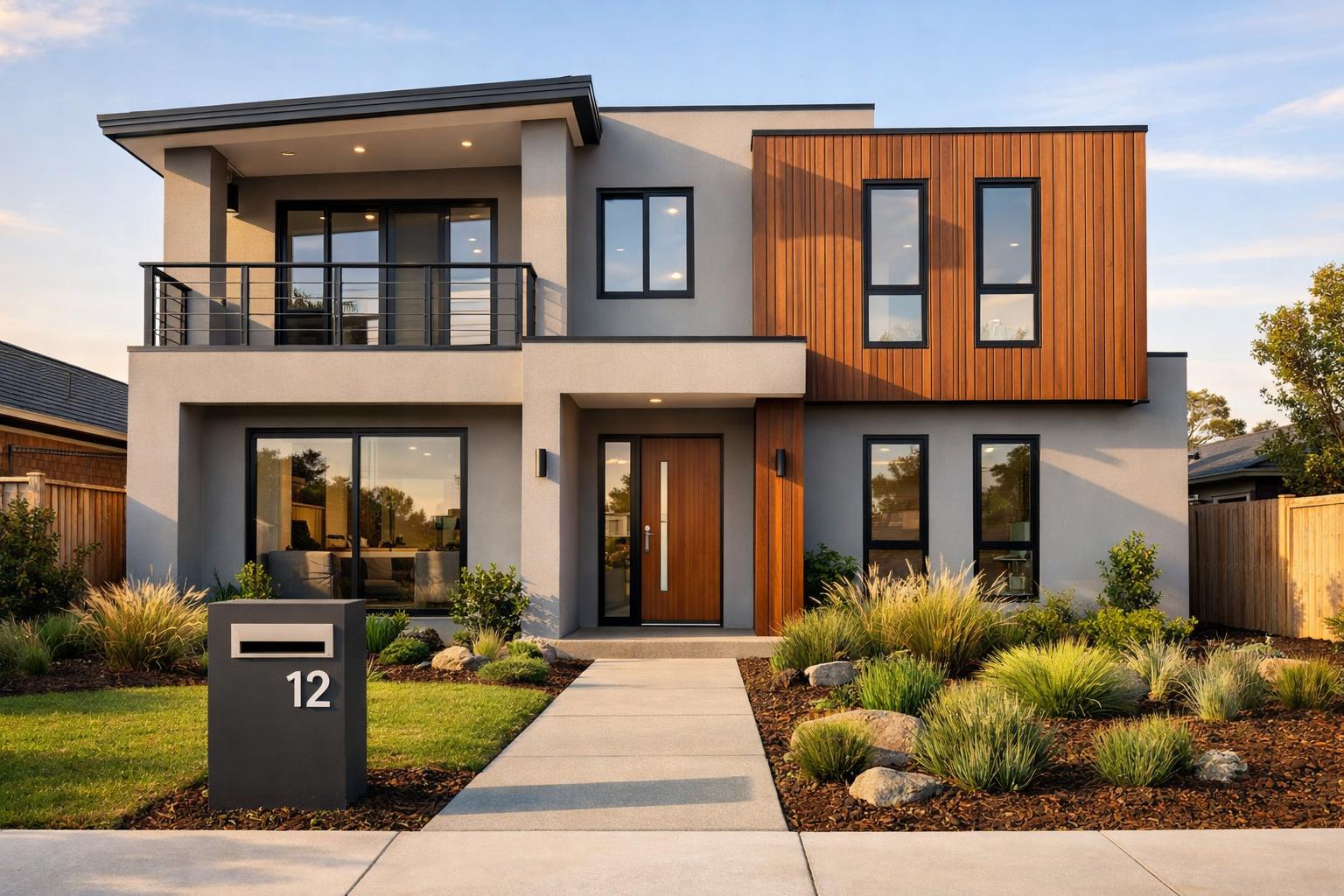
What Is a Class 1b Rooming House in Victoria?
A Class 1b rooming house is a shared home for up to 12 people and 300 square metres. Here's what the Code requires in Victoria and the four approvals it needs.
Rooming House Rules in Victoria: Standards and Registration
What Victorian rooming houses must meet: minimum standards for rooms and shared facilities, council registration, operator licensing and building rules.
Is Negative Gearing Ending? What the 2026 Budget Means for Investors
The 2026 Federal Budget restricts negative gearing to new builds and replaces the 50% CGT discount. What changed, who it hits hardest, and who it does not.
General information only. Nothing on this page is financial, legal or tax advice, and EME Rooming Houses is a property developer, not a licensed financial adviser. Seek independent professional advice before making any investment decision.