
Rooming House Rules in Victoria: Standards and Registration
In short
A Victorian rooming house must be registered with its local council under public health law, run by a licensed operator, and meet minimum standards under residential tenancies law for every room and shared facility. A new one also has to be designed, permitted and classified under the building rules first, usually as Class 1b.
Key takeaways
- Victoria regulates rooming houses in four layers, each under its own law. The council registers the building under public health law, the Business Licensing Authority licenses the operator, Consumer Affairs Victoria oversees the minimum standards, and a registered building surveyor approves the building against the National Construction Code.
- The minimum standards cover each resident's room (a key-free lock from inside, two spare power outlets, a light-blocking window covering, a fixed heater) and the shared kitchen, bathrooms and laundry, down to oven, fridge and washing machine numbers.
- Public health rules set the ratios a council checks: at least one toilet, one bath or shower and one basin for every 10 residents, and no bedroom under 7.5 square metres.
- Operators carry ongoing duties: a gas safety check and an electrical safety check every two years, an evacuation diagram in every room, a statement of rights and the house rules given to each resident, and 24 hours' notice before entering a room.
- For a new build, compliance is designed in. The building class, the planning position, the building permit and the occupancy permit all have to line up before the council will register the house and a licensed operator can open it.

Four pieces of Victorian law touch a rooming house, and each one has its own regulator, its own paperwork and its own idea of what the house has to be. That's the part that trips people up. The rules aren't hard. There are just four sets of them, and they only make sense once you know which body is asking for what.
This guide walks through the layers in the order a house meets them: what makes a building a rooming house in the first place, who regulates it, how council registration and operator licensing work, what every room and every shared facility has to provide, the fire and safety rules, and what all of that means when you're building one from scratch. The last section covers what residents are owed and what happens when a house falls short.
It sits alongside the guide to Class 1b rooming houses, which covers the building classification in detail. That part isn't repeated here.
What counts as a rooming house under Victorian law?
Under the Residential Tenancies Act 1997, a rooming house is a building with one or more rooms available to rent, where the total number of people who may occupy those rooms is four or more. The test is capacity, not who happens to be home on a given day.
The definition sits in section 3 of the Act. What makes a room a "room" here is the shape of the deal: the resident has the right to occupy it, plus the right to use the kitchen, bathrooms and other facilities in common with everyone else. The right to the room is exclusive unless the operator gave written notice before move-in that it's a shared room. Consumer Affairs Victoria puts it plainly: a rooming house is a building where four or more people can live in rented rooms, some of which might be shared.
That's different from a share house, where the whole property is let under one residential rental agreement and the household shares possession of all of it. None of the rooming house rules apply there. The Minister for Housing can also declare a smaller building to be a rooming house under section 19, but that's rare.
"Co-living" is the market's name for a purpose-built rooming house. "Rooming house" is the legal name, and it's the one every regulator uses. The guide to rooming houses, co-living and boarding houses sets the three terms side by side.
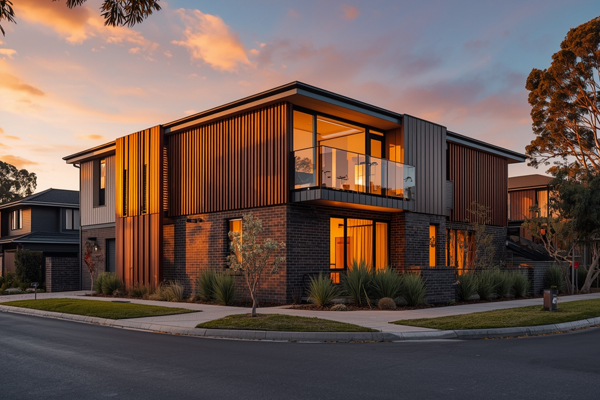
A purpose-built co-living home. In law it's a rooming house from the day four or more people can rent rooms in it, and every rule in this guide applies.
Who regulates rooming houses in Victoria?
Four bodies share the job. The local council registers the house under public health law. The Business Licensing Authority licenses the operator. Consumer Affairs Victoria oversees the minimum standards and residents' rights under tenancy law. And a registered building surveyor, under the Building and Plumbing Commission's regime, approves the building itself against the National Construction Code.
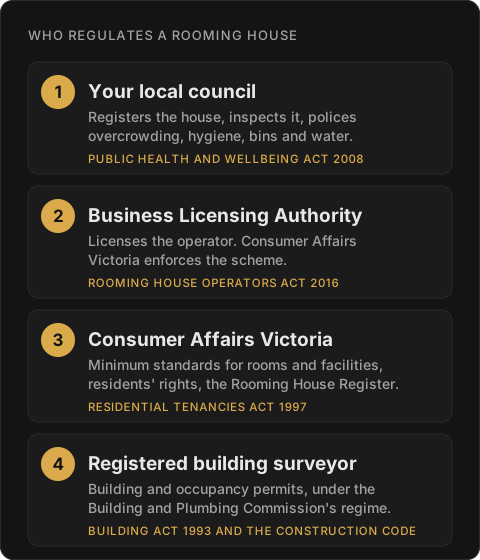
Four laws, four regulators. Each one asks a different question of the same building, and each expects the layer before it to be in place.
| Who | What they regulate | Under |
|---|---|---|
| Your local council | Registration of the house as prescribed accommodation, inspections, overcrowding, hygiene, bins and water. Also planning permits and, through its municipal building surveyor, some building matters | Public Health and Wellbeing Act 2008 and the Public Health and Wellbeing (Prescribed Accommodation) Regulations 2020; the planning scheme |
| Business Licensing Authority, with Consumer Affairs Victoria | The operator's licence: who is allowed to run a rooming house | Rooming House Operators Act 2016 |
| Consumer Affairs Victoria | The minimum standards for rooms and facilities, residents' rights, house rules, entry, repairs, and the state-wide Rooming House Register | Residential Tenancies Act 1997 and the Residential Tenancies (Rooming House Standards) Regulations 2023 |
| A registered building surveyor, under the Building and Plumbing Commission | The building permit and occupancy permit: classification, fire safety, access and construction standards | Building Act 1993, Building Regulations 2018 and the National Construction Code |
Disputes between residents and operators end up at VCAT. Fire Rescue Victoria has a formal say only on the building permit for specific fire-safety systems, such as hydrants and alarm panels connected to a monitoring service, which a small rooming house rarely has.
Everything in this guide is general information. The detail on any given project sits with the council, Consumer Affairs Victoria and the building surveyor.
How does rooming house registration with the council work?
A rooming house is "prescribed accommodation" under the Public Health and Wellbeing Act 2008, and section 67 says the proprietor must register it with the council for the municipal district it sits in. Registration has to be in place before residents move in and kept current while the house is in use.
Registration is local. The council whose district the house is in takes the application, sets the fee, inspects the house and holds the register.
The application goes on the council's own form with the particulars the Regulations prescribe: the proprietor's name and address, the address of the premises, the proposed registration date, and a plan of the building drawn at 1:100 or better showing what each room is for. A rooming house application also carries the applicant's ABN or ACN. The fee is whatever the council has set by resolution, so it varies from one council to the next.
Before it decides, the council can inspect the house, ask for more information, and require alterations so the house complies with the Act, the Regulations and the rooming house minimum standards. It can register the house on condition that those works are done. The Act lets a council set the registration period at anything up to three years. In practice most councils renew annually, and the state register notes that renewals usually run from 1 January to 31 March. Registration can be transferred when a house is sold, with the council's approval.
The public health rules the council enforces are the ones residents notice first. Under the Prescribed Accommodation Regulations 2020, no room under 7.5 square metres can be a bedroom. For stays over 31 days, a bedroom under 12 square metres holds one person, a 12 square metre room holds two, and each extra 4 square metres adds one more. There has to be at least one toilet, one bath or shower and one wash basin for every 10 residents or part of 10. Bedrooms, bathrooms, kitchens and common areas have to be kept clean and in good repair, with hot and cold water to every fixture and vermin-proof bins that are emptied regularly. The proprietor also keeps a register of who's living there, with arrival and departure dates, for 12 months. Councils inspect at least once a year.
Operating unregistered is an offence carrying up to 60 penalty units for a person or 300 for a company. At the 2026-27 penalty unit of $209.10, that's $12,546 and $62,730.
Consumer Affairs Victoria rolls every council's register into the state-wide Rooming House Register, which anyone can search free by suburb, postcode, address, council or operator. It shows each registered house's address and the proprietor's name and ABN or ACN. If you own a building but don't operate it, and you suspect it's being run as an unregistered rooming house, you have a duty to report it.
Do rooming house operators need a licence?
Yes. Since 26 April 2017, anyone conducting the business of operating a rooming house in Victoria has needed a licence under the Rooming House Operators Act 2016. The Business Licensing Authority grants it, Consumer Affairs Victoria polices it, and the application goes through the myCAV portal.
The point of the scheme is to keep unsuitable people out of the sector. The Authority must grant a licence to a "fit and proper person" and must refuse one to anyone who isn't. Section 17 lists the disqualifying grounds: a conviction in the last 10 years for an offence involving fraud, dishonesty, drug trafficking, sexual slavery, child pornography or violence that carried three months' jail or more; being an insolvent under administration; having had a licence cancelled in the last five years; and a conviction in the last five years for a rooming house offence under the tenancy, public health, building or planning laws. For a company, the same test applies to its officers and managers.
A first licence runs for up to three years and a renewal for three to five. Consumer Affairs Victoria just calls it a three-year licence. It's personal and can't be transferred, and one licence can cover any number of rooming houses. Registered housing associations and housing providers are exempt.
Operating without one is serious. The penalty is 240 penalty units or two years' imprisonment for a person, and 1,200 penalty units for a company, which at 2026-27 rates is $50,184 and $250,920. There's a public register of licensed operators showing each licensee's name, ABN or ACN, and the grant and expiry dates.
The licence attaches to the operator. The registration attaches to the property. A rooming house needs both. The developer, an investor or a specialist manager can hold the licence, but whoever runs the house has to hold one.
What minimum standards must every room meet?
Every resident's room has to meet the Residential Tenancies (Rooming House Standards) Regulations 2023, which replaced the 2012 Regulations on 26 February 2023. Section 142B of the Act says an operator must not provide a room that doesn't comply, and the penalty is 150 penalty units for a person or 750 for a company.
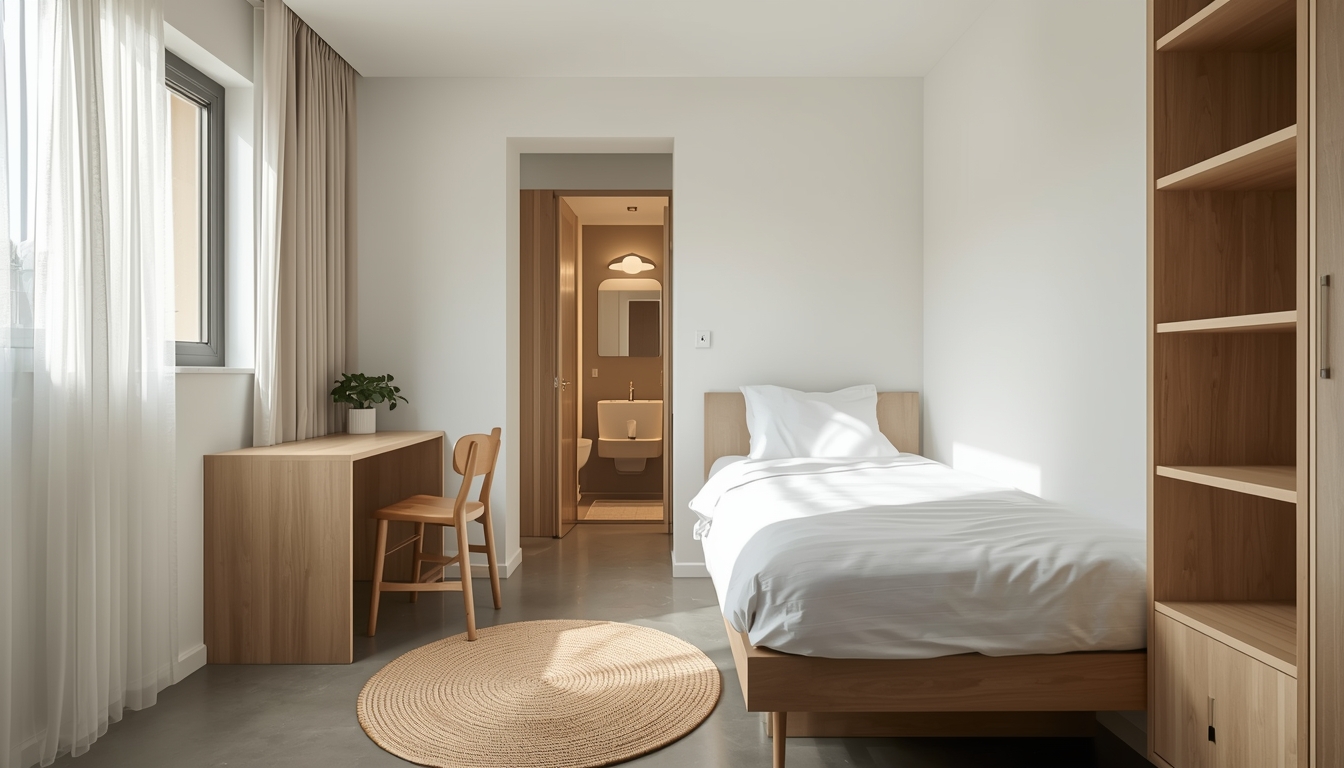
What a resident should find: a door that locks, a window covering that blocks the light, somewhere to plug things in, and a heater. The ensuite is an EME build standard, not a regulation.
The room standards are grouped by where they apply. For the room itself:
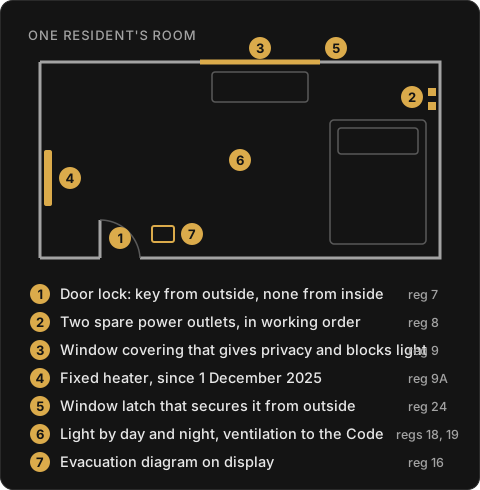
Seven things a resident's room has to have under the 2023 Regulations, with the regulation behind each.
- A lockable door. The lock has to work with a key from outside and open from inside without one. A key fob or PIN code counts as a key.
- Two spare power outlets. At least two unoccupied outlets in safe working order, on top of any the operator's own appliances use, installed by a licensed electrician.
- A window covering the resident can open and close, that gives reasonable privacy and, since 26 February 2025, reasonably blocks light.
- Heating. Since 1 December 2025, a fixed heater in good working order in the room, or an outlet from one, unless that's unreasonable. From 1 December 2030 it has to be an energy-efficient one.
- A window that latches. Every openable external window has a working latch that stops it being opened from outside, and can be fixed open or shut without a key.
- Light and ventilation. Natural light by day, artificial light at night, and ventilation that meets the Building Code for the building's class.
- An evacuation diagram on display in the room.
The operator also can't put more people into an occupied room without written notice and the resident's consent.
The general rental minimum standards that came in on 29 March 2021 are a separate regime, for premises let under a residential rental agreement. A rooming house room is covered by its own standards instead, whether the resident has a rooming house agreement or an individual rental agreement, and Consumer Affairs Victoria says so on its rental standards page. Since 13 October 2026, operators have also had to keep records showing the house meets the standards, and produce them when asked.
What standards apply to shared kitchens, bathrooms and laundries?
The shared facilities have to be enough for the maximum number of residents the house can hold, kept in working order, and meet set standards for privacy, hygiene and safety. The numbers in the 2023 Regulations are specific, and they're worked out on that maximum, not on who's living there this week.
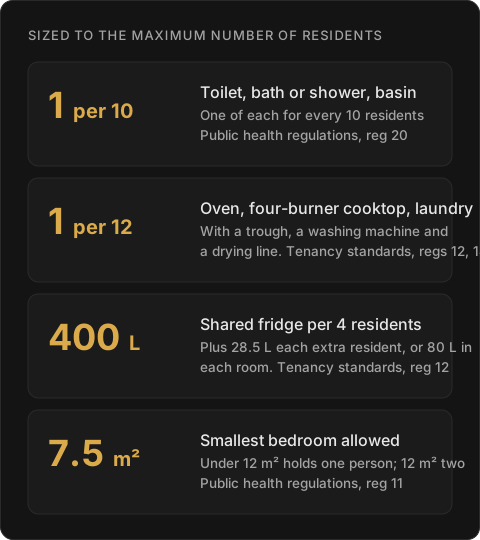
The ratios, and which law each comes from. The bathroom numbers and the bedroom size are public health rules the council checks. The rest are tenancy standards Consumer Affairs Victoria oversees.
Bathrooms and toilets. The public health rule is at least one toilet, one bath or shower and one basin for every 10 residents or part of that. On top of that, the tenancy standards require every shared bathroom and toilet door to have a bolt or catch that latches securely from inside without a key, fitted by a qualified person. A cabin hook doesn't count. Shower heads have to be three-star water rated.
The kitchen. A sink and a food preparation area used only for food preparation, either in the room or a common area. For every 12 or fewer residents who don't have cooking facilities in their room, an oven in working order and a four-burner cooktop in a common area. Fridge space of at least 80 litres in each resident's room, or in a common area 400 litres for every four or fewer residents, plus 28.5 litres for each resident after that. A cupboard of at least 0.10 cubic metres for each resident, lockable if it's in a common area.
Somewhere to eat. Enough chairs for the maximum number of residents and a table or tables to fit them. A benchtop can count as a table as long as it's not the food preparation area.
The laundry. For every 12 or fewer residents: a trough with hot and cold water, a space with outlets for a washing machine, a washing machine, and a clothes line or drying facility.
The house. Structurally sound and weatherproof, and free from mould and damp caused by the building itself. External entrances lock with a key from outside and open without one from inside. There's a window, peephole or intercom at the main entrance, and outside lighting at night. Corridors and hallways have to be lit too.
The operator is responsible for keeping all of it in working order. The Director of Consumer Affairs Victoria can exempt a house from some of the standards on application, but never from the room lock, the power outlets, the bathroom latch, the evacuation diagram, the electrical safety switch, or the gas and electrical safety checks.
What fire and safety rules apply to rooming houses?
There are two sets, and they come from different places. The building's fire safety is set at the design stage by the National Construction Code and the building permit. The operator's ongoing safety duties come from the tenancy standards, and they run for as long as the house is open.
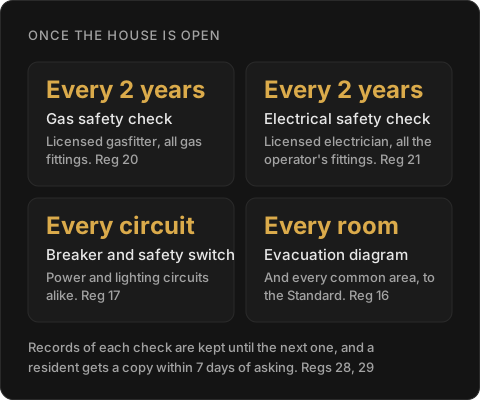
The cycle an operator runs. The building's smoke alarms were approved on the way in; these are the duties that keep going.
At the building stage. A Class 1b rooming house has a smoke alarm in every bedroom, in every hallway that serves a bedroom, and on each other storey. The alarms run off the mains and are interconnected, so when one sounds they all do, and the hallway lighting comes on with the alarm to help people get out. That's Part 9.5 of the Housing Provisions, and it's covered in detail in the Class 1b guide. The Housing Provisions don't call for sprinklers in a Class 1b building.
A building that's too big for Class 1b is Class 3, and Class 3 is assessed under Volume One of the Code, which is written for larger buildings. That brings in fire-resisting construction set by the number of storeys, the egress rules in Section D, fire-fighting equipment and an automatic smoke detection system. Sprinklers throughout the building come in once it has a rise of four storeys or more. For an older building being converted, the Building Regulations 2018 separately require any Class 1 or Class 3 building built or permitted before 1 August 1997 to have a mains-powered smoke alarm system.
Once it's open. The tenancy standards require every power and lighting circuit to be protected by a circuit breaker and a safety switch. An evacuation diagram to the Australian Standard has to be displayed in every resident's room and every common area. Where the house has gas, a licensed gasfitter has to check all the gas installations and fittings every two years. A licensed electrician has to check all the electrical installations, appliances and fittings the operator provides at least every two years. If either check hasn't been done in the last two years when a resident moves in, it has to be done as soon as practicable. The operator keeps a record of each check until the next one: the tradesperson's name and licence number, the date and the results. A resident who asks in writing gets a copy within seven days.
Councils inspect too. Their authorised officers can inspect any prescribed accommodation, and the public health regime treats overcrowding, poor maintenance and unsanitary facilities as registration matters.
What do the rules mean when building a new rooming house in Victoria?
For a new rooming house, the rules shape the design from the first sketch. The building class, the planning position, the building permit and the fire safety features all have to line up so the finished house can be registered, licensed and opened. Get the sequence right and each approval leads into the next.
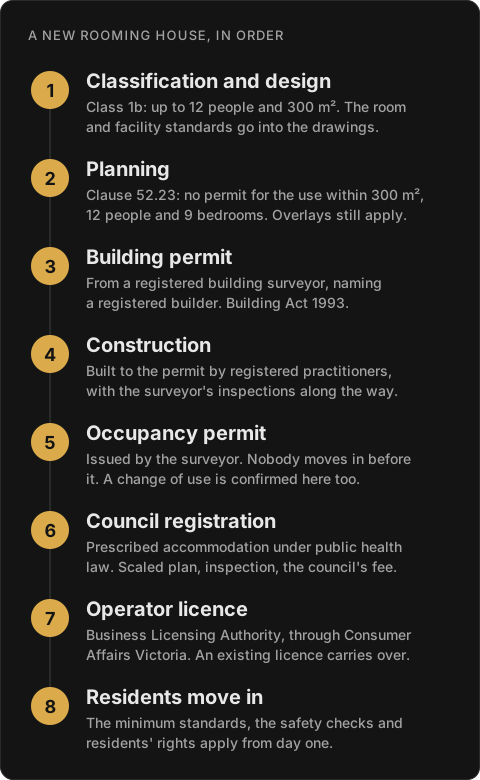
Eight steps, in order. The standards in this guide apply from the day residents move in, so they have to be drawn in at step one.
- Classification and design. A rooming house for up to 12 people within 300 square metres is a Class 1b building under the Code, and Victoria adopted the current edition, NCC 2025, on 1 May 2026. Above either limit it's Class 3, with the heavier rules described above. The Class 1b guide covers why so many small rooming houses are designed to stay inside those limits. The room and facility standards go into the drawings here: the room sizes, the outlets, the bathroom count, the kitchen and laundry provisions, and one accessible bedroom with its bathroom plus access to each kind of shared room, which Volume One requires of a Class 1b building.
- Planning. Clause 52.23 of the Victoria Planning Provisions removes the need for a planning permit to use land for a rooming house in the General Residential, Neighbourhood Residential, Residential Growth, Mixed Use, Township and several other zones. The conditions are a total floor area of no more than 300 square metres, no more than 12 people accommodated and no more than nine bedrooms. A matching exemption for the buildings and works applies in the main residential zones if the bedrooms are reached from inside the building, there's a shared entry and common areas including a kitchen and living area, and the garden area rule is met. An overlay can still require a permit, so planning is checked site by site. Where a planning permit is needed, the council issues it before the building permit.
- The building permit. Under the Building Act 1993, building work can't start without a building permit, issued by a registered building surveyor who's satisfied the work will comply with the Act, the Regulations and the Code. The permit names the builder and says whether an occupancy permit will be required on completion. For work over $10,000, the builder has to be a registered building practitioner.
- Construction. Built to the permit by registered practitioners, with the surveyor's mandatory inspections along the way.
- The occupancy permit. Where the building permit says one is required, nobody can occupy the building until the surveyor has issued it. For a conversion rather than a new build, the Building Regulations say the building's use can't change unless it meets the requirements for the new use, and the occupancy permit is where that's confirmed.
- Council registration. The public health application described above, with the scaled plan and the proprietor's details. The council can inspect before it registers and can require alterations first. The primary sources don't say whether a council will register a house before it has an occupancy permit, so expect to show your building and planning approvals, and check the council's own practice.
- The operator licence. Whoever will run the house applies to the Business Licensing Authority. An existing licence covers a new house.
- Residents move in. From that day the minimum standards, the safety checks and the residents' rights all apply.
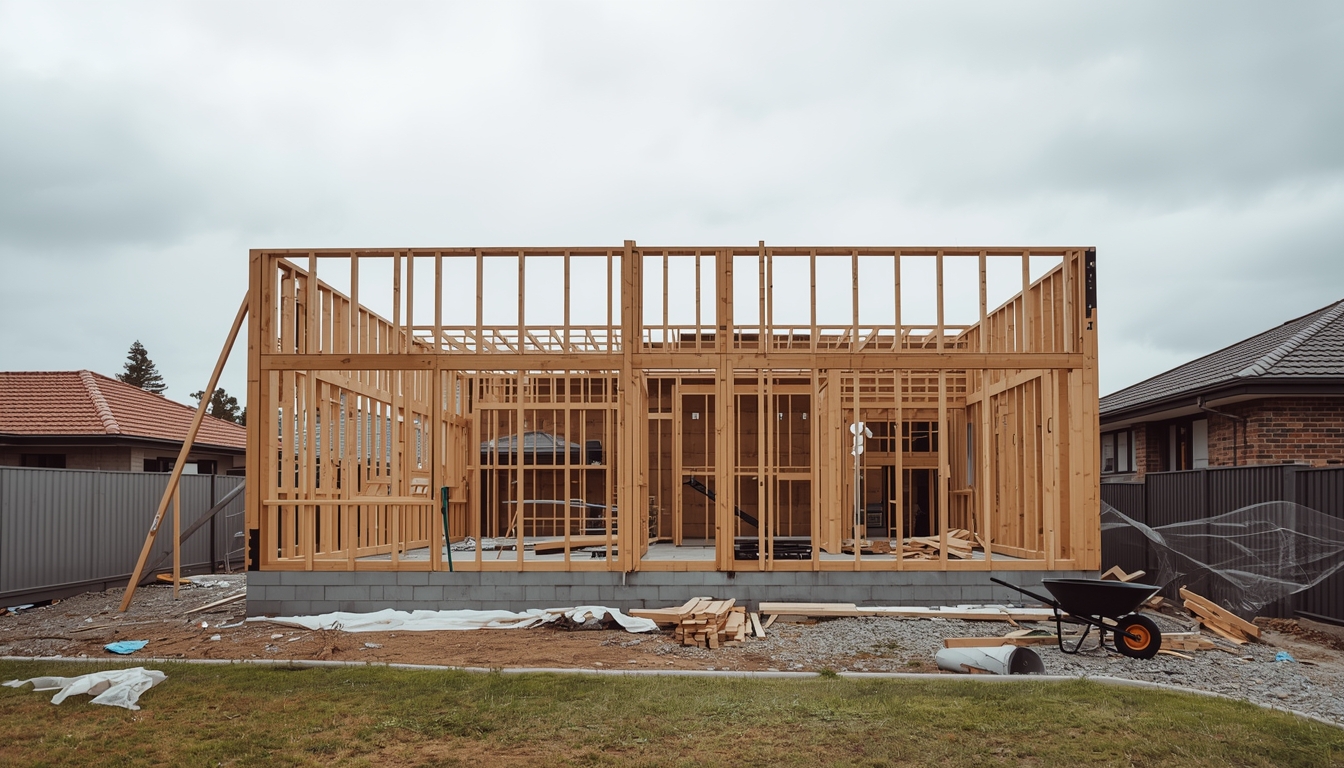
By the time the frame is up, the classification, the planning position and the building permit are settled. The standards were designed in before that.
If you build or project-manage rooming houses, you carry both rulebooks at once: the Code and the building permit for the structure, and the room and facility standards for what goes inside it. A nine-room home that passes its occupancy permit but has one 400 litre fridge for nine residents, or no bolt on a shared bathroom door, isn't ready to register. The regulatory side is one of the risks a developer manages on a project of this size, alongside the others set out in understanding risk in small-scale development. The cost side of building has been moving too, as the piece on construction costs explains.
At EME, I design every home to the Class 1b limits and the rooming house standards from the first drawing. Nine private rooms, each with its own ensuite and kitchenette, which is well beyond what the Regulations ask for. The shared kitchen, living and laundry are sized to the standards, and the safety checks are scheduled before the first resident arrives. Compliance is the floor a home has to clear, not a target. It goes into the project plan at the start, not a checklist at the end. How I assess a site before any of this starts is for the planned feasibility guide, and my career history is on my profile.
What must an operator provide to residents, and what happens if standards are not met?
Operators owe residents information as well as a compliant room. Before a resident moves in, the operator has to give them a written statement of their rights and duties in the form Consumer Affairs Victoria approves, a copy of the house rules, and written notice of the operator's full name, an address for serving documents and an emergency phone number for urgent repairs. A one-page version of the statement and the house rules also has to be on prominent display in each resident's room. If the room is a shared one, that has to be disclosed in writing before move-in, along with how many people it can hold.
The operator sets the house rules but can't change them without seven days' written notice, and a resident can ask VCAT to declare a rule unreasonable. A fixed-term rooming house agreement has to be in writing on the prescribed form.
Entry. For most reasons, such as repairs or showing the room to a prospective resident, an operator can enter a resident's room with at least 24 hours' notice, between 8 am and 6 pm on any day except a public holiday. A general inspection needs 48 hours' notice and can't happen more than once every four weeks. No notice is needed if the resident agrees at the time, in an emergency to save life or property, or to provide services in the hours the house rules set.
Repairs. The operator has a duty to keep the room and the shared facilities in good repair. If the operator doesn't deal with an urgent repair immediately, the resident can arrange it themselves and must be reimbursed within seven days, up to the amount the Regulations allow, which Consumer Affairs Victoria puts at $2,500. For a non-urgent repair not done within 14 days of written notice, the resident can ask the Director of Consumer Affairs Victoria to investigate, and then apply to VCAT, which has to hear the matter within seven days.
Enforcement. Each regulator holds its own lever. The council can refuse, suspend or cancel a registration, including for failing the minimum standards, and can prosecute for operating unregistered. Consumer Affairs Victoria investigates and prosecutes breaches of the tenancy standards, with penalties of up to 150 penalty units for an operator who provides a non-compliant room. VCAT hears residents' applications. And the Business Licensing Authority can refuse to renew, or cancel, an operator's licence, with convictions for rooming house offences under any of these laws counting against the operator for five years.
For broader questions about co-living and about EME, see our full FAQ. The rules above are current as published and are general information only. Confirm the detail with your council and Consumer Affairs Victoria before relying on it, because councils differ in practice and the standards have been changing year by year. There are more rooming house and co-living guides in the resource hub, and if you'd like to talk through a project, you can book an introductory call with Georgia from the homepage.
Sources
- Victorian Legislation, Residential Tenancies Act 1997
- Victorian Legislation, Residential Tenancies (Rooming House Standards) Regulations 2023
- Victorian Legislation, Public Health and Wellbeing Act 2008
- Victorian Legislation, Public Health and Wellbeing (Prescribed Accommodation) Regulations 2020
- Victorian Legislation, Rooming House Operators Act 2016
- Victorian Legislation, Building Act 1993
- Victorian Legislation, Building Regulations 2018
- Consumer Affairs Victoria, Rooming house minimum standards
- Consumer Affairs Victoria, Rooming house operators' gas and electrical obligations
- Consumer Affairs Victoria, What must an operator give a new resident
- Consumer Affairs Victoria, When a rooming house operator can enter a room
- Consumer Affairs Victoria, Rooming house operators licensing scheme
- Consumer Affairs Victoria, Search registered rooming houses
- Consumer Affairs Victoria, Public register of rooming house operators
- Australian Building Codes Board, National Construction Code 2025, Volume Two, Part A6 Building classification
- Australian Building Codes Board, ABCB Housing Provisions, Part 9.5 Smoke alarms and evacuation lighting
- Australian Building Codes Board, National Construction Code 2025, Volume One, Part E1 Fire fighting equipment
- Building and Plumbing Commission (Victoria), When is a building permit required?
- Department of Transport and Planning (Victoria), Victoria Planning Provisions, Clause 52.23 Rooming house
- Victorian Government, Notice fixing the value of a fee unit and a penalty unit for 2026-27
Common questions
Is a share house the same as a rooming house in Victoria?
No. In a share house the whole property is rented under one residential rental agreement and the people living there share possession of all of it. In a rooming house each resident has their own right to occupy a room, usually an exclusive one, plus the right to use the shared facilities, and the operator chooses who lives there. The rooming house rules only apply to the second arrangement.
Can a rooming house operate without council registration?
Not lawfully. Under the Public Health and Wellbeing Act 2008 the proprietor of a rooming house must register it with the council for the area it sits in, and operating unregistered is an offence. The council can also refuse, suspend or cancel a registration if the house doesn't meet the public health rules or the rooming house minimum standards.
Where can I check whether a rooming house is registered in Victoria?
Consumer Affairs Victoria runs the Rooming House Register, a state-wide list built from every council's own register. Anyone can search it free by suburb, postcode, address, council or operator, and see the address of each registered house with the proprietor's name and ABN or ACN. A separate public register lists licensed rooming house operators.
Do rooming house residents sign a lease?
Usually not a lease in the ordinary sense. Most residents have a rooming house agreement, which can be unwritten for a periodic stay, though a fixed-term rooming house agreement has to be in writing on the prescribed form. Before a resident moves in the operator has to give them a written statement of their rights and duties, a copy of the house rules, and the operator's name, address and an emergency contact number.
Who do residents contact if a rooming house does not meet the minimum standards?
Start with the operator, who has a duty to keep the house in good repair. If a non-urgent repair isn't done within 14 days of a written request, a resident can ask Consumer Affairs Victoria to investigate and then apply to VCAT. Public health problems like overcrowding or unsanitary facilities go to the council's environmental health team, which registers the house.
Related reading
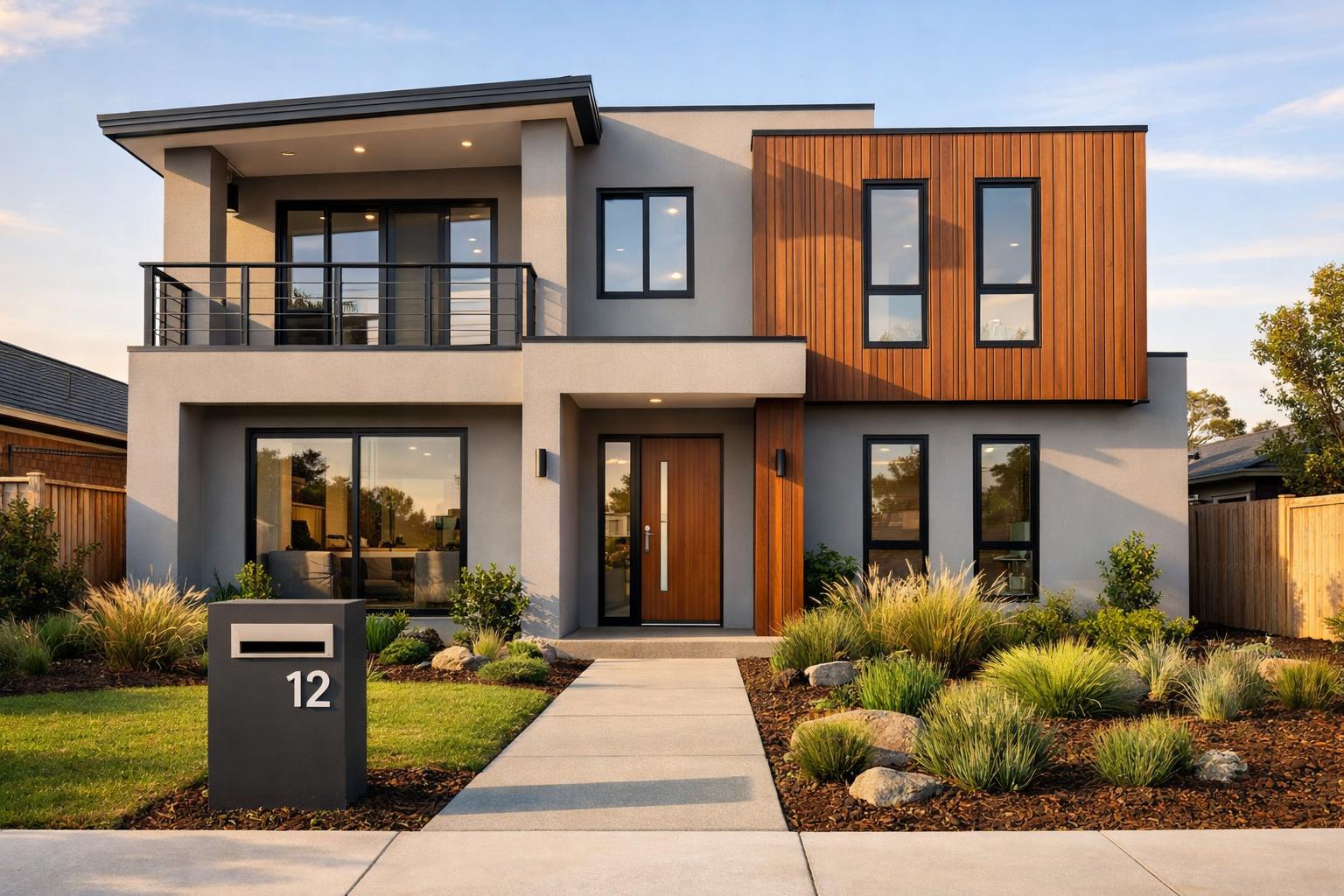
What Is a Class 1b Rooming House in Victoria?
A Class 1b rooming house is a shared home for up to 12 people and 300 square metres. Here's what the Code requires in Victoria and the four approvals it needs.
Rooming House vs Co-Living vs Boarding House
In Victoria, 'rooming house' is the legal term. Learn how it differs from co-living and boarding houses, which rules apply and what each term means in practice.
Is Negative Gearing Ending? What the 2026 Budget Means for Investors
The 2026 Federal Budget restricts negative gearing to new builds and replaces the 50% CGT discount. What changed, who it hits hardest, and who it does not.
General information only. Nothing on this page is financial, legal or tax advice, and EME Rooming Houses is a property developer, not a licensed financial adviser. Seek independent professional advice before making any investment decision.