
How Second-Mortgage Development Lending Works
In short
In second-mortgage private development lending, a private lender lends to a property project under a contract setting the rate, term and repayment. The loan is secured by a mortgage over the land that ranks behind the senior lender, so if the property is sold or the loan is enforced, the senior lender is paid first. Capital is at risk.
General information only. Nothing on this page is financial, legal or tax advice, and EME Rooming Houses is a property developer, not a licensed financial adviser. Seek independent professional advice before making any investment decision.
Key takeaways
- A private development loan is a contract. The loan documents set the rate, the term, the repayment and the security, not how profitable the project turns out to be.
- A second-ranked mortgage means the senior lender is repaid first from any sale or enforcement, and the private lender only from what's left. That's the main reason the position carries more risk than first-ranked lending.
- The loan is normally repaid at the end, when the finished property is sold or refinanced, so repayment depends on the building being completed and that exit happening.
- In Victoria a mortgage counts as a security over the land once it's registered, and mortgages rank in the order they're lodged for registration. An executed mortgage held unregistered until a default gets its place in line on the day it's lodged.
- "Fixed" means contractual, not guaranteed. Read the loan agreement, the mortgage and the exit plan, and get independent legal and financial advice before you lend.
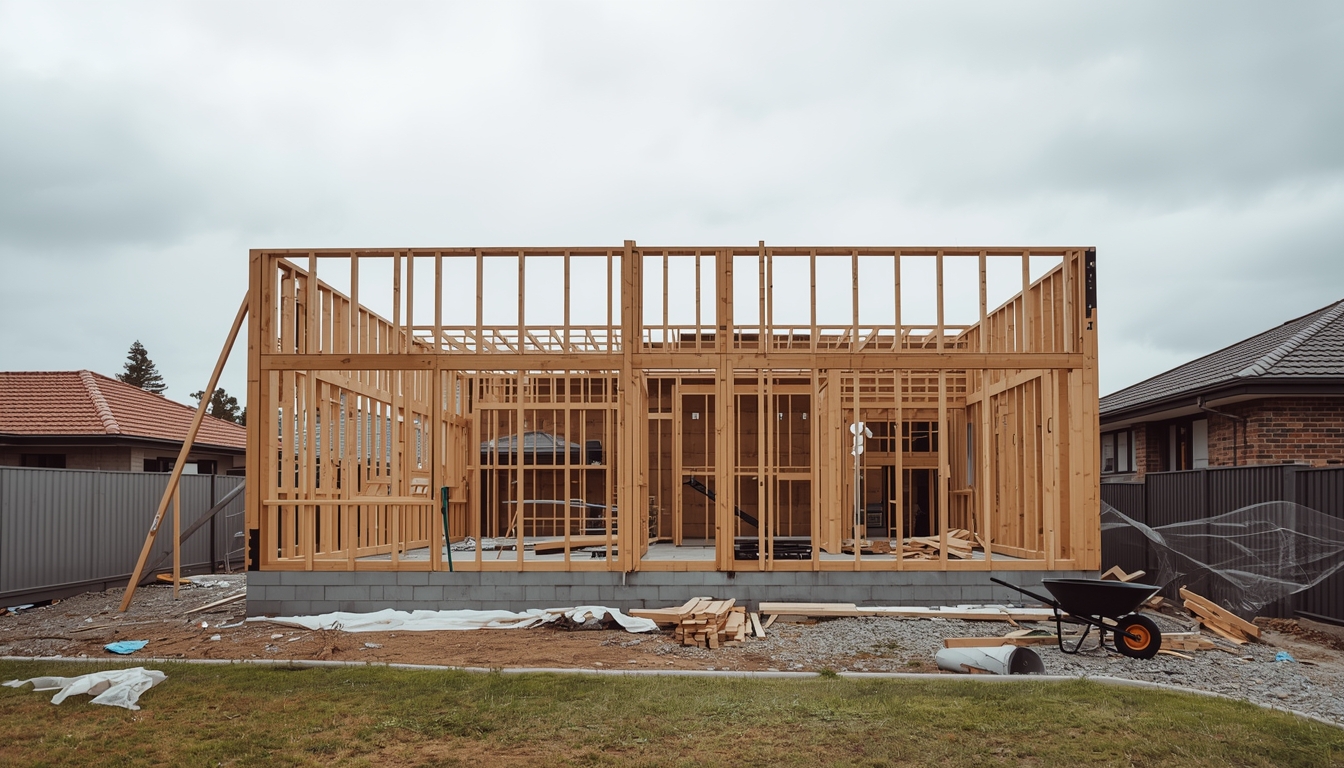
Most people meet development lending the same way. A project needs money, the bank will lend part of it, and someone offers a private loan at a fixed rate to cover the rest. The rate is what everyone notices. The structure behind it is what decides what you're actually exposed to: who you're lending to, what security you hold, where you rank and how you get your money back.
This guide walks through that structure in plain terms: the three parties to a development loan, why developers borrow privately at all, what a second mortgage means, how registration works on a Victorian title, how interest is set and paid, how the loan is repaid and what happens if it isn't. The last section explains how EME uses private development lending for its own projects. It's general information about how this kind of lending works, not a recommendation to lend.
What is private development lending?
Private development lending is a loan from a private individual or entity to a property development project, made under a written loan agreement and usually secured by a mortgage over the development land. The lender earns interest set by the contract rather than a share of the project's profit.
There are three parties. The developer is the borrower, often through a company set up to own and build the one project. The senior lender, usually a bank or a non-bank lender, provides the main construction loan and holds a first mortgage over the land. The private lender lends under its own loan agreement and, in the structure this guide covers, holds a second mortgage that ranks behind the first.
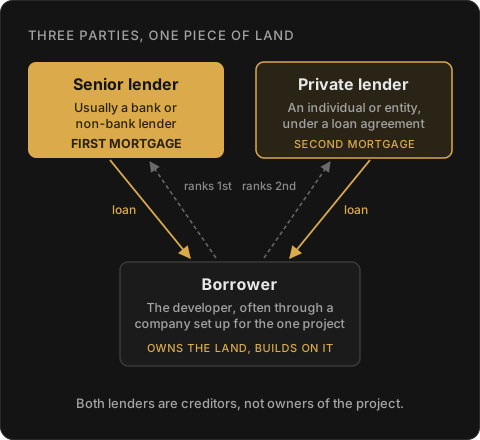
Two lenders, one borrower, one piece of land. The order the mortgages rank in decides who's paid first.
The private lender is a creditor, not an owner. It's owed its capital and the interest the contract sets, and nothing more, whether the project makes a large profit or a thin one. Owning a share of the project is a different arrangement with a different risk, and this guide isn't about that.
Who can lend is limited too. Outside registered managed investment schemes, offers of private development loans are generally made only to wholesale or sophisticated investors, who get fewer of the protections the law gives retail investors. As Moneysmart puts it, being offered something as a wholesale investor "is not a sign that an investment is safe, suitable or likely to perform well".
Why do property developers borrow from private lenders?
Senior lenders usually fund only part of a project's costs. Developers fill the gap between the senior loan and their own contribution with other capital, and private lending is one way to do it.
Think of the money in a development as a stack. At the bottom is the senior loan, secured by the first mortgage and repaid first. At the top is the developer's own contribution, its equity, which is repaid last and absorbs any loss first. Between them sits whatever fills the gap: a private loan, sometimes called mezzanine or subordinated debt, secured by a second mortgage and repaid after the senior lender but before the developer.
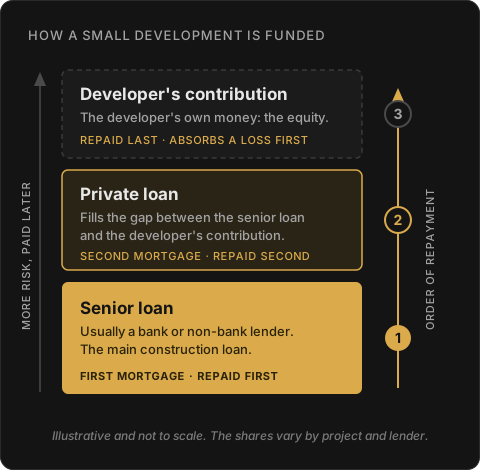
The stack from the bottom up is also the order of repayment. The higher a slice sits, the more risk it carries.
The Reserve Bank has tracked how this market grew. Its 2017 review of lending to the residential property market found that banks had reduced their appetite for development lending after reassessing the risk, and that developers generally had to put in more of their own money as a result. In April 2019 it described developers turning to non-bank lenders as banks pulled back. Those lenders generally asked for fewer presales and allowed more borrowing, but charged much higher interest rates, and much of what they lent was mezzanine debt, ranked below the senior debt. By November 2026 it estimated that non-bank lenders, private credit funds included, made up at least 40 to 50 per cent of lending for residential property construction.
For a small-scale developer the reasons are practical. A private loan can be arranged for one project at a time, its terms can be shaped around that project's timing, and it can cover a share of the cost the bank won't. None of that makes borrowing privately a sign of strength or of weakness. It's a funding choice. The questions worth asking are about the project and the terms, not the choice itself.
What does a second mortgage mean in a development loan?
A second mortgage is security over the same land that ranks behind the first mortgage. If the property is sold or the loans are enforced, the proceeds go to the first mortgagee until it's repaid, and only then to the second mortgagee.
The order is written into Victorian law. When a mortgagee sells under its power of sale, section 77(3) of the Transfer of Land Act 1958 sets how the money is applied: first the costs of the sale and of the default, then the debt under the mortgage being enforced, then later mortgages in the order of their priority, and only then anything left to the owner. Ranking is the whole game for a second-ranked lender, because it decides what's left by the time the money reaches you.
A worked example makes it concrete. The numbers below are made up and rounded, and they aren't EME figures. Say the senior lender is owed $1.0 million and the private lender $0.4 million, interest included, and the finished property is sold.
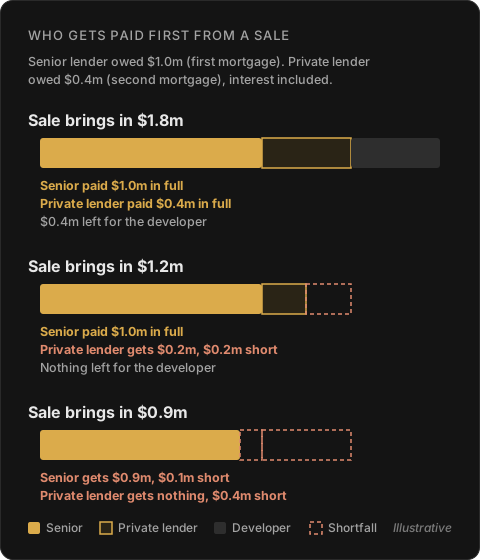
The same two loans, three different sale prices. The second-ranked lender feels a shortfall first.
If the sale brings in $1.8 million after costs, both lenders are paid in full and $0.4 million is left for the developer. At $1.2 million, the senior lender is still paid in full, but the private lender gets $0.2 million and is $0.2 million short. At $0.9 million, the senior lender takes everything and is itself $0.1 million short, and the private lender gets nothing at all. The developer's equity sits above both loans and is lost first, which is why a lender wants to know how much of the developer's own money is in the project.
The order of two mortgages over the same land can also be changed by agreement. Section 75B of the Act lets registered mortgagees vary their priority by an instrument in the approved form, signed by each mortgagee that's being postponed. Separately, lenders often set out between themselves, in a priority or subordination deed, how they'll rank and act. Whether a senior lender will agree to any of this is a commercial question. Many won't consent to a second mortgage being registered while their loan is in place.
A mortgage is security, and security gives the lender rights over the land if the borrower defaults. It doesn't make a loan safe, and it can't make the land worth more than it sells for.
What is the difference between a registered mortgage and one that is registrable on default?
A registered mortgage is recorded on the land title, while a mortgage that's executed but registrable on default is signed now and can be lodged for registration if the borrower defaults. The difference affects when and how the lender's interest appears on title.
Victorian land runs on the Torrens system, where the title register is the record of who owns what and who holds what over it. Under the Transfer of Land Act 1958, a mortgage takes effect as a security over the land "when registered" (section 74(2)). Mortgages over the same land rank according to the order in which they're lodged for registration, not the date they were signed (section 34(1)). A registered mortgagee can use the statutory remedies on default: notice, sale and possession under sections 76 to 78.
An executed mortgage that's registrable on default is fully signed at the start of the loan and held by the lender, ready to lodge. It isn't recorded on the title while the loan runs normally. If the borrower defaults, the lender lodges it for registration, and from then it ranks like any other registered mortgage. Lenders and borrowers use it when the senior lender won't consent to a second mortgage going on the title in advance, since registering one without consent could put the senior loan in default and with it the project.
Three points in the Act bear on the period before registration, and a lender needs to understand all three:
- Place in line. Because priority follows the order of lodgment, the mortgage takes its place on the day it's lodged. Anything lodged on the title before then, such as another mortgage or a transfer, ranks ahead of it. A later party's knowledge of the unregistered mortgage doesn't change that (sections 42 and 43).
- Caveats. Someone claiming an interest under an unregistered instrument can lodge a caveat, which stops later dealings affecting that interest being registered while it's in force (sections 89 and 91). A caveat doesn't affect anything lodged before it (section 91(2)), it can lapse or be removed through the processes in sections 89A and 90, and it doesn't stop a sale by the first mortgagee (section 91(2A)).
- The first mortgagee's part. To register a mortgage behind a first mortgage, the first mortgagee has to produce the certificate of title or provide an administrative notice when asked (section 86). How quickly that happens in practice depends on the senior lender and the electronic conveyancing process.
None of this makes the structure better or worse in the abstract. It's a trade-off that suits some projects, and it's exactly the kind of thing to have your own lawyer read before you lend: the mortgage itself, the conditions for lodging it, and any caveat or other step the loan agreement provides for.
How is the interest rate set and paid?
The rate is fixed in the loan contract at the start, so it doesn't rise or fall with the project's profit. That makes it contractual, not guaranteed: it's only paid if the borrower meets its obligations.
That's the difference between lending and owning. An equity investor's return depends on how the project turns out. A lender's return is set at the start and doesn't grow if the project does better than expected. What can change is whether it's paid in full and on time, which depends on the borrower and the project.
Interest is usually handled one of two ways. It can be paid as it accrues, monthly or quarterly through the term. Or it can be capitalised: added to the loan balance as it accrues and paid in one amount with the capital at the end, so the lender waits longer for its money and has more riding on the exit.
Either way, the money has to come from somewhere, and a building site doesn't earn rent. ASIC's 2025 report on private credit in Australia puts it plainly: on a development loan there's "no or insufficient income to pay interest and, as such, interest is either capitalised or paid from the drawdown of capital", and the capital and interest come back "from selling or refinancing the completed project". So interest paid during the build usually comes out of money the project has borrowed for the purpose, not out of income. The offer terms set which method applies, the rate, the term and any minimum.
"Fixed" means the rate is contractual, not tied to project profit, but it is not a guarantee. This is a secured, second-ranked private lending position: your capital is at risk, and your return depends on the project and EME meeting their obligations. The opportunity is offered only to wholesale or sophisticated investors, and we recommend independent advice.
How does a private lender get repaid?
Development loans are usually repaid in one amount at the end of the term, from the sale of the completed property or from a refinance onto longer-term debt. So repayment depends on the project being completed and that exit happening on time.
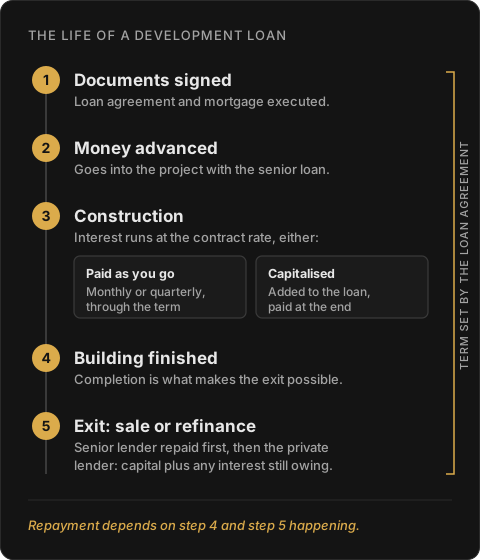
Five steps from signing to repayment. The last two are the ones repayment depends on.
The exit is the event the whole loan is built around. A finished building can be sold, or it can be refinanced: the owner takes out a longer-term loan against the completed, income-producing property and uses it to pay out the construction lenders. Either way, the senior lender is repaid first from the proceeds and the private lender after it.
Timing matters as much as the price. A building that finishes late reaches its exit late, and a sale or refinance can take longer than planned. For the private lender, a delay usually means a longer wait for its capital. What else follows depends on the loan agreement, which is why the terms on extensions, default interest and the developer's obligations during a delay are worth reading closely.

Completion is what turns a building site into an asset that can be sold or refinanced. Until then the exit is a plan.
Moneysmart's guide to mortgage schemes makes the same point about development loans in general: they carry "the risk that the development project will not be completed and the developer may not be able to repay the loan." Repayment is never certain. It rests on the building being finished, on the exit happening and on the proceeds covering the debts ahead of yours.
What happens if the developer cannot repay?
If the borrower defaults, the lenders can take enforcement action under their mortgages, which may lead to a sale of the property. The first mortgagee is paid from the proceeds first, and the second-ranked lender may recover less than it lent, or nothing.
Victorian law sets out the sequence for a registered mortgage. If a default in payment or another breach continues for one month, or another period the mortgage sets, the mortgagee can serve written notice on the borrower to pay or put it right (section 76 of the Transfer of Land Act 1958). If the notice isn't met within one month of service, or the period the mortgage sets, the mortgagee can sell, by auction or private contract, in good faith and with regard to the owner's interests (section 77(1)). It can also take possession and collect any rent (section 78). The proceeds are then applied in the order set out earlier: costs first, then the mortgages in their order of priority, and only then the owner.
For a second-ranked lender, the senior lender's moves often decide the outcome. A sale by the first mortgagee pays the first mortgage before anything reaches the second. A sale by the second mortgagee doesn't clear the first mortgage off the title (section 77(4) frees the land only from the selling mortgage and those recorded after it). And any mortgagee can pay out a mortgagee that's demanding payment and take over its mortgage (section 87), which is one way a second-ranked lender can take control of the timing, at the cost of more capital. A lender whose mortgage is registrable on default has to register it before it can use these statutory steps. Any priority deed between the lenders can change how all of this plays out.
The mechanics are only part of the picture. Construction costs, delays, the market at the time of sale and the developer's own position are what decide whether a default happens at all. They're covered in understanding risk in small-scale development. The plain point here is that capital lent on a second mortgage can be partly or wholly lost.
What should a lender check before lending to a developer?
Before lending, read the loan agreement and mortgage in full, understand where your loan ranks and what the senior lender's terms are, know how and when the loan is meant to be repaid, and get independent legal and financial advice.
A practical list:
- The loan agreement. The rate, the term, how interest is paid, what counts as a default, and what happens on a delay or an extension.
- The mortgage. Whether it'll be registered at the start or held unregistered until a default, what triggers lodgement, and whether a caveat or other step is provided for.
- The priority position. What the senior lender has lent, on what terms, and whether there's a priority or subordination deed between the lenders.
- Guarantees. Who, if anyone, guarantees the loan personally, and what that guarantee covers.
- The numbers. The valuation, the project budget, the developer's own contribution, and how much room there is between the debts and the expected sale price. Ask whether a loan-to-value ratio is measured against the site as it is or as if complete: ASIC's 2025 private credit report warns that quoting it on completion value "can understate risk throughout the construction period".
- The interest. Whether it's paid through the term or capitalised, and if it's paid during the build, where that money comes from.
- The exit. How the loan will be repaid, by sale or refinance, and what happens if that takes longer than planned.
- The developer. Its track record on projects of this size and type, and how it has handled delays before. Ask how the site was assessed and why it was judged feasible.
If you're thinking of lending through a self-managed super fund, there are specific rules for SMSF trustees. Get independent advice on your own circumstances before you do.
This is general information. A good lawyer and an independent financial adviser will see things in the documents that a guide can't.
How does EME Rooming Houses use private development lending?
EME funds each new Class 1b rooming house partly through private development lending from wholesale or sophisticated investors: a fixed-rate loan to the project, set by contract, secured by an executed mortgage, registrable on default, in a second-ranked position.
At EME, I develop new Class 1b rooming houses in regional Victoria: purpose-built co-living homes with nine private rooms, each with an ensuite and kitchenette, designed to Victoria's rooming house rules and minimum standards from the first drawing. Each project sits in its own company, set up for that one site, and that company is the borrower. A senior construction lender holds the first mortgage. Private lenders lend to the project under a written loan agreement, at a rate fixed by contract, with their loan secured by an executed second mortgage over the development site, registrable on default, ranking behind the senior construction lender, and with personal guarantees from the principals.
We hold the second mortgage unregistered until a default because senior construction lenders don't typically consent to a second mortgage going on the title while their loan is in place, and registering one in advance could put the senior loan, and with it the project, at risk. If the borrower defaults, the mortgage is lodged for registration and a caveat can be lodged too. Interest is either paid through the term or capitalised and paid at the end, depending on the engagement, and the rate differs between the two. The rate, the term and the minimum are in the offer terms, which we go through on an introductory call. The documents are yours to take to your own lawyer, and I'd encourage you to.

The finished building is what repays the loan, by sale or refinance. Everything before that is what the loan pays for.
For more on how EME works with lenders, the co-living investor FAQ covers the questions that usually come next, and my background and the projects behind it are on my profile page.
"Fixed" means the rate is contractual, not tied to project profit, but it is not a guarantee. This is a secured, second-ranked private lending position: your capital is at risk, and your return depends on the project and EME meeting their obligations. The opportunity is offered only to wholesale or sophisticated investors, and we recommend independent advice.
If you'd like to talk it through, you can book an introductory call from the homepage.
Sources
- Victorian Legislation, Transfer of Land Act 1958, Authorised Version No. 184
- Federal Register of Legislation, Corporations Act 2001, sections 708, 761G and 761GA
- ASIC, Report 814: Private credit in Australia (September 2025)
- ASIC, Report 820: Private credit surveillance, retail and wholesale funds (November 2025)
- Moneysmart, What is a wholesale investor
- Moneysmart, What is private credit?
- Moneysmart, Develop an investing plan
- Moneysmart, Investing in mortgage schemes?
- Reserve Bank of Australia, Shadow Bank Lending to the Residential Property Market, Bulletin, September 2017
- Reserve Bank of Australia, Box D: Non-bank Lending for Property, Financial Stability Review, April 2019
- Reserve Bank of Australia, Financial Conditions, Statement on Monetary Policy, November 2026
- Reserve Bank of Australia, Resilience of the Australian Financial System, Financial Stability Review, October 2026
Common questions
Is a second mortgage riskier than a first mortgage?
Generally, yes. The two mortgages are over the same land, but the first is paid out first from any sale. If the sale doesn't cover both debts, the shortfall lands on the second-ranked lender before it touches the first. Moneysmart's general rule applies: the higher the expected return on an investment, the higher the risk.
Can a second mortgage lender force the sale of a property?
A registered second mortgagee has the same statutory power of sale as any mortgagee under the Transfer of Land Act 1958. After a default has continued for a month it can serve notice, and if the notice isn't met within another month it can sell, unless the mortgage sets different periods. The sale doesn't clear the first mortgage, and in practice the senior lender's own position usually shapes what happens. A mortgage that isn't yet registered has to be registered first.
Is interest on a development loan paid during the loan or at the end?
Either, depending on the loan terms. Some loans pay interest monthly or quarterly through the term. Others capitalise it: the interest is added to the balance and paid in one amount with the capital at the end. Because a building under construction earns no income, interest paid during the build usually comes from money borrowed for the purpose rather than from rent.
Do I need to be a wholesale or sophisticated investor to lend to a developer?
For a private loan offered directly to you, rather than through a registered managed investment scheme, generally yes. The Corporations Act 2001 sets the tests, in sections 708, 761G and 761GA. Whether you meet one is a question for your accountant or adviser. Moneysmart explains what changes when you're treated as a wholesale investor, including protections that may no longer apply, such as a disclosure document and access to AFCA.
Related reading

Is Negative Gearing Ending? What the 2026 Budget Means for Investors
The 2026 Federal Budget restricts negative gearing to new builds and replaces the 50% CGT discount. What changed, who it hits hardest, and who it does not.

Should You Build Co-Living During the 2026 Oil Shock?
Oil past $100/barrel. Diesel at $3/litre. PVC up 27%. Why rising construction costs make income-producing co-living development more urgent, not less.

How Does Co-Living Earn 2–3x the Rental Yield in Australia?
61% of Australian households are one or two people, yet 6% of homes have one bedroom. The structural case for co-living investment, and how EME delivers it.
General information only. Nothing on this page is financial, legal or tax advice, and EME Rooming Houses is a property developer, not a licensed financial adviser. Seek independent professional advice before making any investment decision.