
Negative Gearing Is Dying. Our Investors Never Needed It | EME Rooming Houses
EME ROOMING HOUSES | INVESTOR INTELLIGENCE
Negative Gearing Is Dying.
Our Investors Never Needed It.
How the 2026 Federal Budget’s confirmed reforms to negative gearing and the CGT discount strengthen the case for purpose-built co-living, and weaken the case for everything else.
Published May 2026 | Updated with confirmed budget details | emeroominghouses.com

On the evening of 12 May 2026, Treasurer Jim Chalmers handed down what he described as the most significant tax reform in more than a quarter of a century. The speculation is over. The budget papers are published. And the negative gearing and capital gains tax changes that had been rattling the conventional property market for months are now government policy, pending legislation.
The reaction has been swift and predictable. Property lobby groups are warning of a rental market collapse. Media commentators are calling it the end of property investment. Social media is full of investors who believe they have been betrayed.
But the reforms do not apply equally to all property investors. They apply overwhelmingly to one type of investor, the holder of existing residential property, and they explicitly protect another: the investor who builds new housing supply.
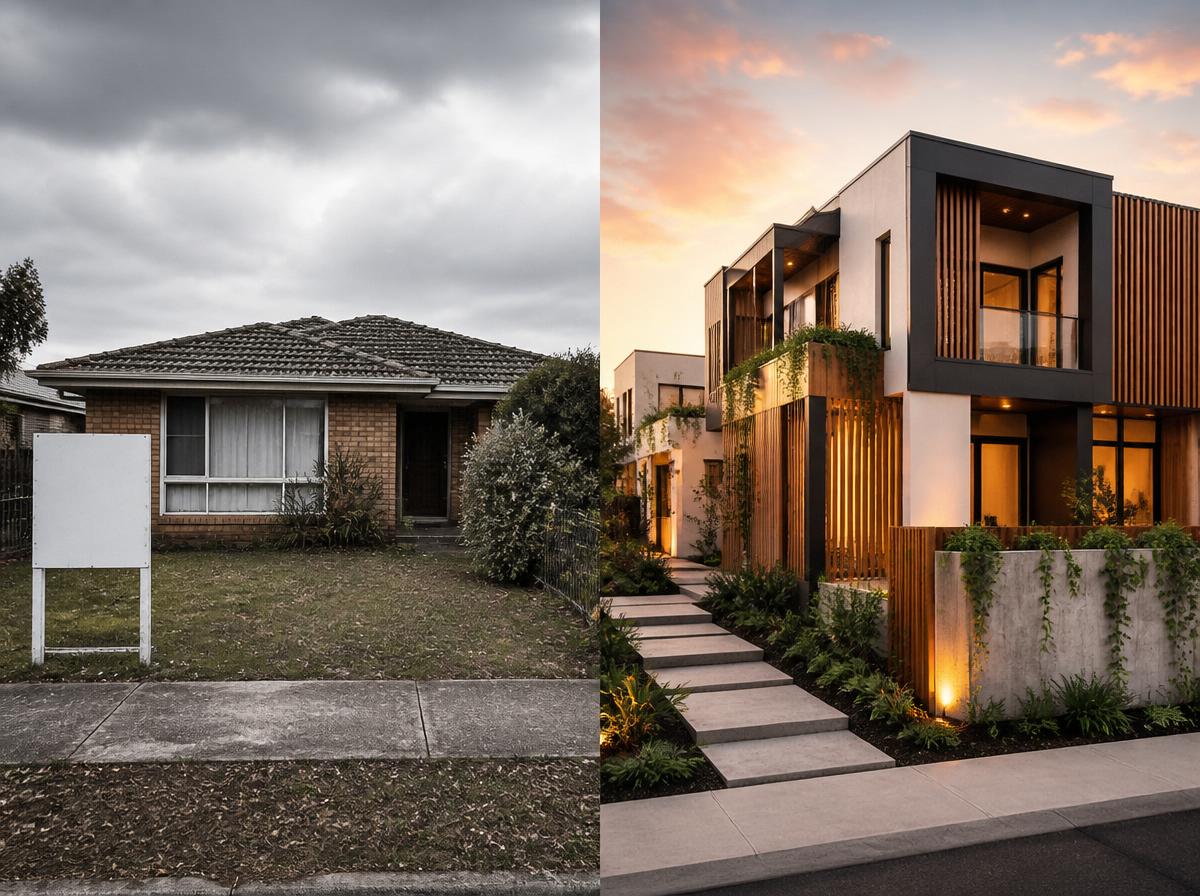
Purpose-built co-living rooming houses are new builds. They are new residential construction on previously vacant or redeveloped land, designed from the ground up to add to the housing stock. Under the confirmed reforms, this model retains every tax advantage that the conventional investor would otherwise lose.
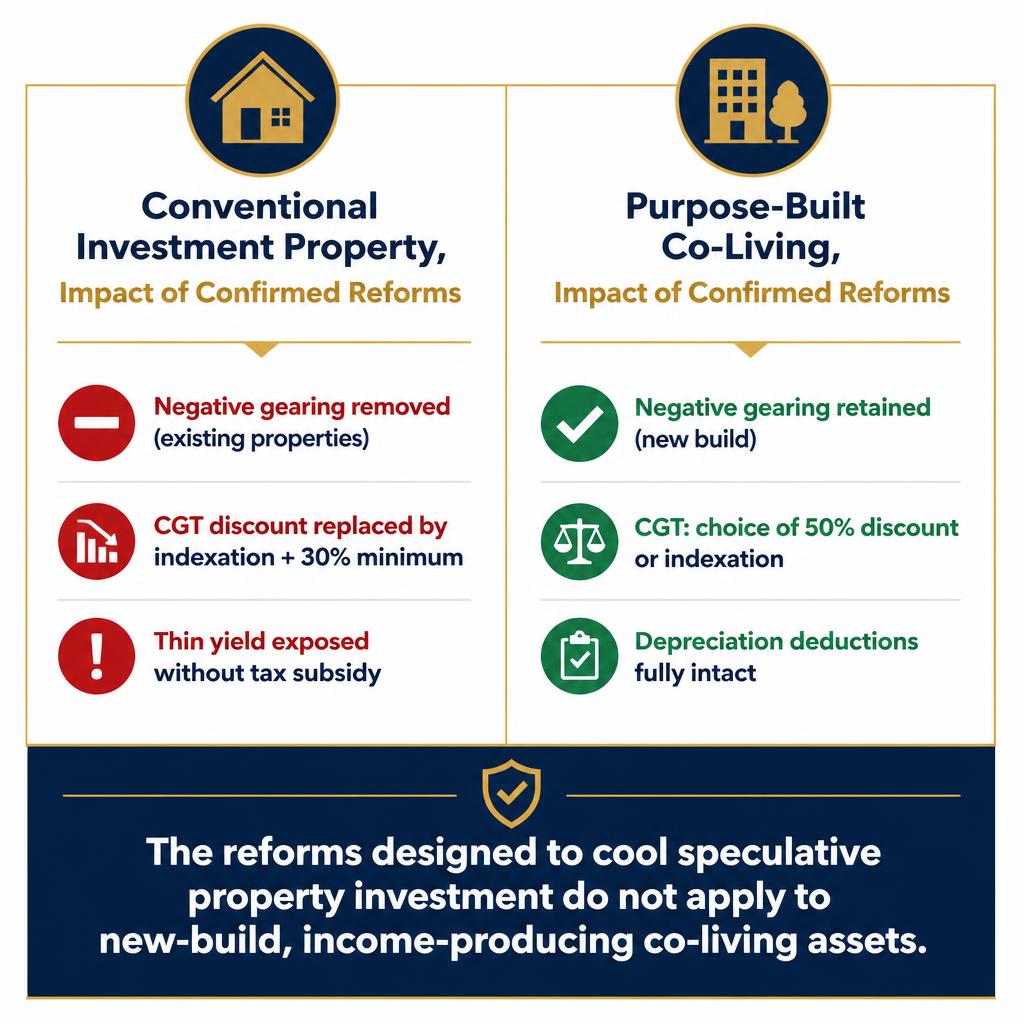
The government has drawn a clear line: investors who add to housing supply keep their entitlements. Investors who compete for existing stock do not.
Purpose-built co-living sits definitively on the right side of that line.
Part 1: What the Budget Confirmed
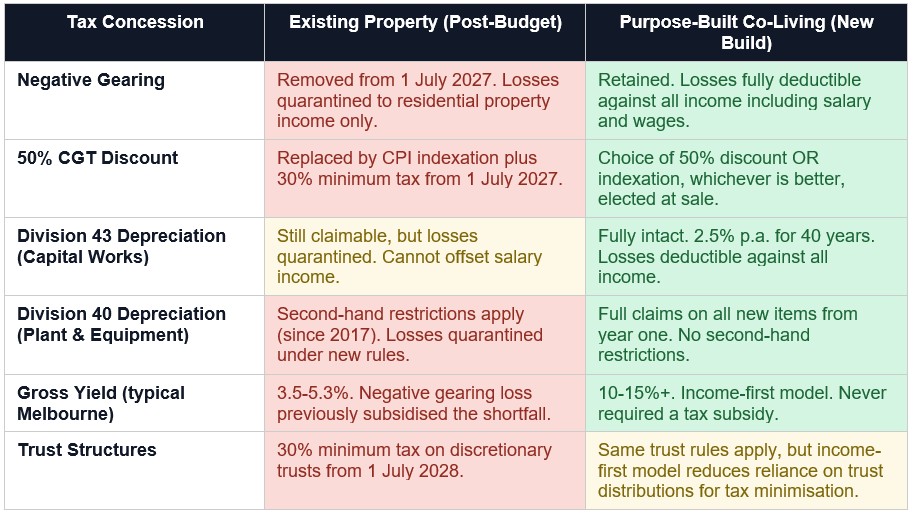
Negative gearing: restricted to new builds from 1 July 2027
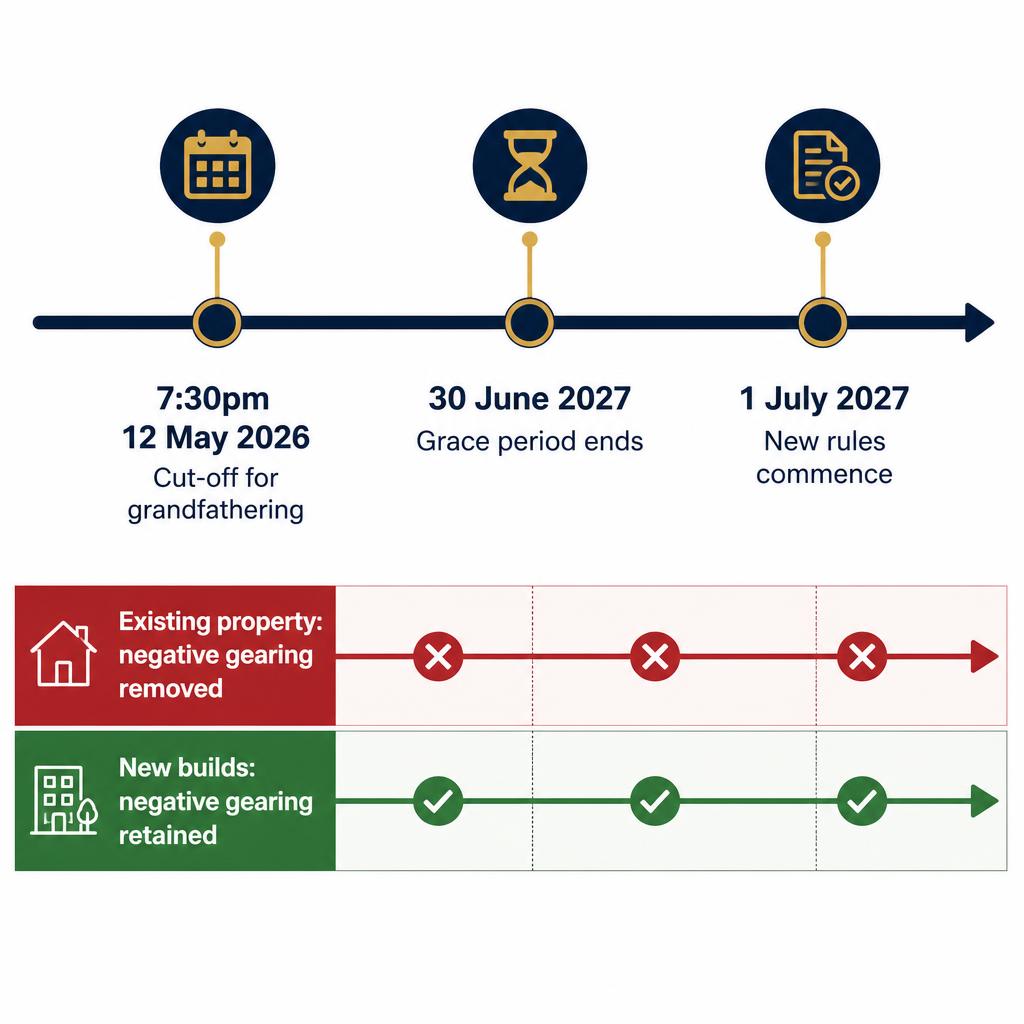
From 1 July 2027, negative gearing for residential investment property will be limited to new builds that genuinely add to housing supply. For established residential properties purchased after 7:30 pm AEST on 12 May 2026, rental losses will be quarantined. They can only be offset against other residential property income, including rental income and capital gains from residential properties, not against salary, wages, or other personal income. Excess losses can be carried forward, but they no longer reduce your annual tax bill in the way negative gearing has traditionally worked.
Existing investments are grandfathered. Properties held, or under an exchanged contract, before 7:30 pm on Budget night retain their current negative gearing treatment until sold. This applies regardless of how many properties an investor holds.
There is a transitional grace period. Properties purchased between Budget night and 30 June 2027 can still be negatively geared during that financial year, but not from 1 July 2027 onwards.
The new build exemption is the critical detail.
Properties that qualify as new builds remain fully eligible for negative gearing, both before and after 1 July 2027. Investors can continue to deduct rental losses from a new build against all other taxable income, including salary and wages, exactly as the system works today.
The budget defines a ‘new build’ as a residential property that genuinely adds to the housing stock. This includes newly constructed apartments bought off-the-plan, duplexes or multi-dwelling developments constructed through knock-down rebuilds that produce a net increase in dwelling numbers, any residential construction on previously vacant land, and newly built properties that have not been previously sold or occupied for more than twelve months.
It explicitly excludes renovations or extensions that do not increase the number of dwellings, such as like-for-like knock-down rebuilds and granny flats added to existing properties.
An important nuance applies to knock-down rebuild projects. The budget examples make clear that demolishing one house and replacing it with a single new house does not qualify. However, the budget also states that knock-down rebuilds producing a net increase in the number of residential properties do qualify. Where EME demolishes a single dwelling and constructs a purpose-built rooming house with nine individually tenanted rooms, the building classification changes from a Class 1a to Class 1b dwelling, with the housing contribution being nine separate tenancies replacing one. Whether this is assessed by formal dwelling count or by the broader "genuinely adds to housing stock" test will depend on the final legislation. We believe the policy intent strongly favours inclusion, and we will update this analysis once the legislation is confirmed.
Additional exemptions apply to widely held managed investment trusts, superannuation funds including SMSFs, targeted build-to-rent developments, and private investors participating in government housing programs.
A purpose-built co-living rooming house is new residential construction that genuinely adds to housing supply, whether built on vacant land, through subdivision, or by replacing a single home with multi-tenancy accommodation that materially increases the number of households housed on the site.
On projects where EME builds on vacant land or subdivides to create additional titles, new-build status is clear-cut. On knock-down rebuild projects where a single dwelling is replaced by a nine-tenancy rooming house on the same title, the formal dwelling count is one-for-one, but the practical housing contribution is nine households where previously there was one.
The overarching policy test, "genuinely adds to housing stock", supports this classification. The final legislative definition will confirm the position, and we are tracking the consultation process closely.
Capital gains tax: the 50% discount is being replaced
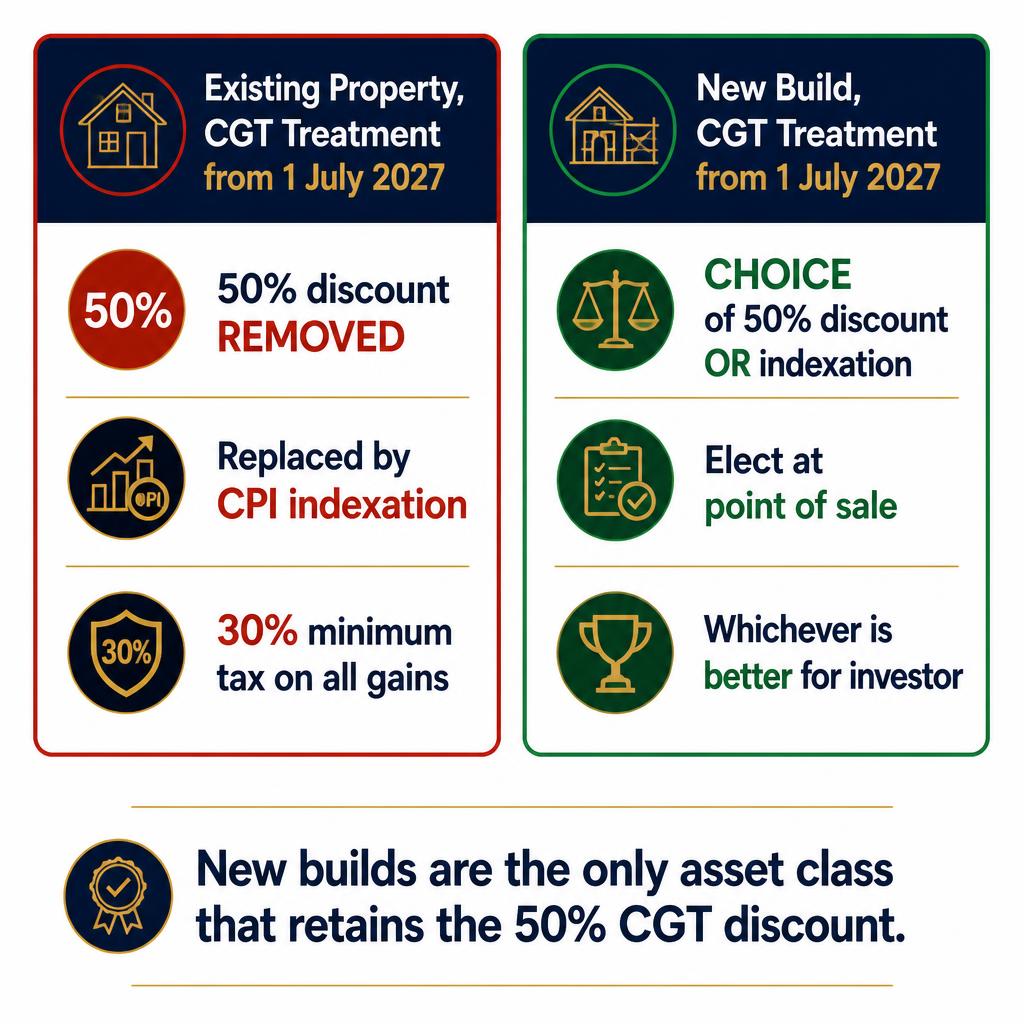
From 1 July 2027, the longstanding 50 per cent CGT discount will be replaced by a cost base indexation model. Instead of automatically halving the capital gain, the ATO will index the asset's original purchase price for inflation before calculating the taxable gain. Investors will pay tax only on the real capital gain, the portion above inflation, restoring the system that operated between 1985 and 1999.
There is also a new minimum 30 per cent tax rate on capital gains. This was not widely anticipated before the budget and represents a significant change. It means there is no longer a benefit in timing the sale of an asset to coincide with a year of low personal income. Capital gains will always be subject to at least 30 per cent tax, regardless of the investor’s marginal rate.
The changes are prospective. Gains accrued on existing investments before 1 July 2027 retain the 50 per cent discount. Only gains arising after that date fall under the new arrangements. For assets held across the transition, a time-apportionment method will be used.
New builds receive preferential CGT treatment.
Investors in eligible new residential properties will be able to choose, at the point of sale rather than at the point of purchase, between the existing 50 per cent CGT discount and the new indexation model with the minimum tax. Whichever produces the better outcome for the investor can be elected with the benefit of hindsight. This is a meaningful structural advantage that no other asset class receives under the reformed system.
Discretionary trusts: a separate but related change
From 1 July 2028, a minimum 30 per cent tax rate will apply to the taxable income of discretionary trusts. This is projected to raise approximately $4.5 billion in its first full year and will affect over 900,000 family trusts across Australia. Rollover relief will be available for three years from 1 July 2027 for small businesses and others wishing to restructure.
For property investors holding assets in discretionary trust structures, this change adds a further layer of complexity to the conventional investment model. The combined effect of negative gearing restrictions, CGT reform, and trust taxation creates a compounding tax headwind for traditional property holdings.
Part 2: What Was Not Changed: Depreciation
This is the detail that matters most for investors in purpose-built co-living, and it is the detail that most commentary has overlooked entirely.
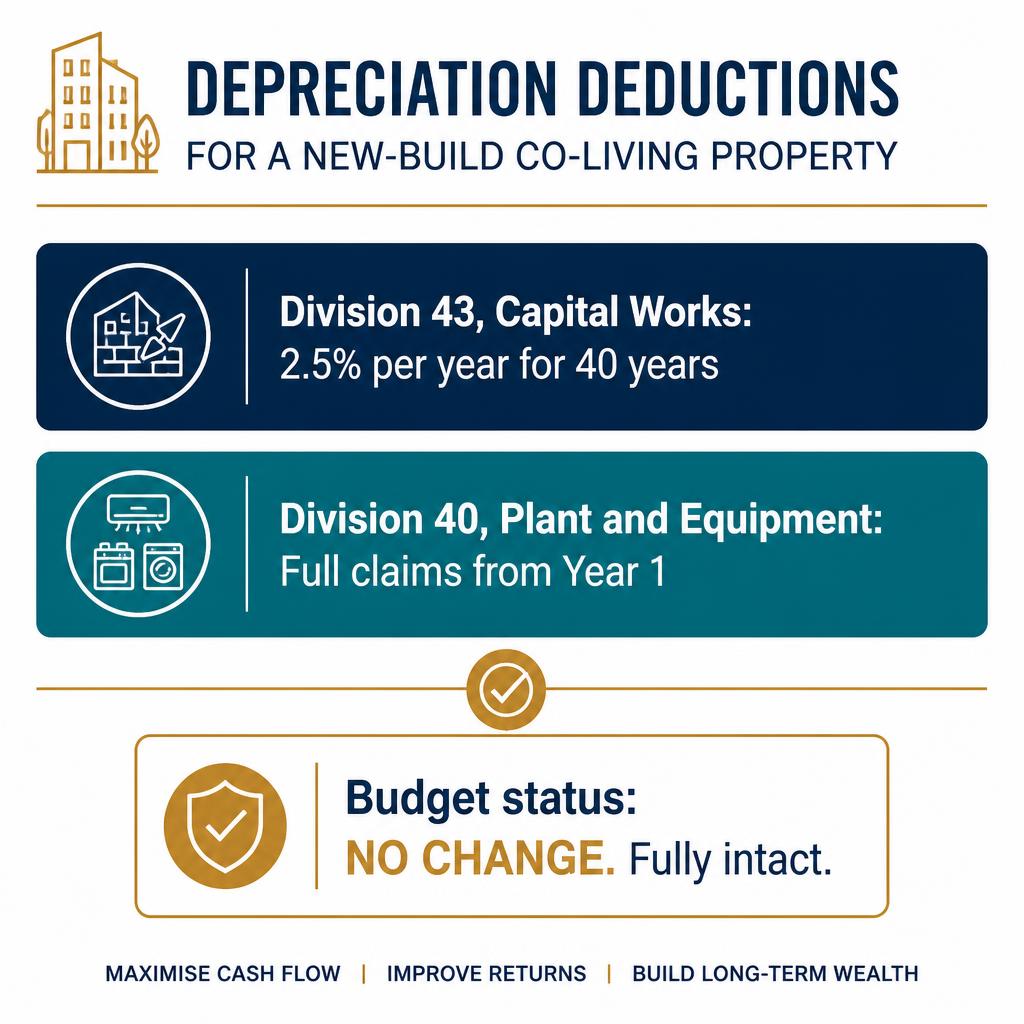
Tax depreciation, both Division 43 capital works deductions and Division 40 plant and equipment deductions, was not touched by the 2026 budget. Not restricted. Not reformed. Not even mentioned as a future target.
For a newly constructed co-living property, the depreciation position is substantial. Division 43 allows the investor to claim 2.5 per cent of the original construction cost per year for up to 40 years, as a flat annual deduction against rental income. On a property with construction costs of $800,000, that is a $20,000 annual deduction for 4 decades.
Division 40 adds further deductions for plant and equipment: appliances, air conditioning, carpets, blinds, hot water systems, and other removable or mechanical assets. Because the property is a new build, the investor claims depreciation on all of these items at full value from year one. There are no second-hand restrictions. The 2017 rule that prevents depreciation claims on pre-existing plant and equipment in established properties does not apply to new construction.
For an established property purchased after Budget night, depreciation deductions still apply, but under the new rules, the rental losses they generate can only be offset against other residential property income, not against salary or wages. The depreciation is still claimable; the loss it generates is quarantined.
For a new build, the loss remains fully deductible against all income. Depreciation continues to function exactly as it does today.
Depreciation is the engine of the after-tax return in a purpose-built co-living investment.
That engine is completely untouched by the 2026 reforms.
Part 3: Reform Impact: Traditional Property vs. Purpose-Built Co-Living
T
Part 4: Why This Model Was Never Dependent on Negative Gearing
The conventional property investment model in Australia has been built, for decades, on a specific tax architecture: buy an existing property at a thin or negative yield, claim the rental loss against personal income, hold for capital growth, and sell at a 50 per cent CGT discount. Remove any one of those structural supports, and the model is under pressure. Remove two simultaneously, and the model is fundamentally compromised.
The 2026 budget has removed both for established property purchases. For new builds and projects that genuinely add to the housing supply, the entitlements remain.
Purpose-built co-living was never built on that architecture. It was built on income. A well-designed co-living home in metropolitan Melbourne generates gross rental income exceeding $185,000 per year from a single residential site. A traditional rental on the same street might return $30,000. That is not a marginal improvement. It is a fundamentally different asset class operating under the same zoning laws, on the same land, in the same suburbs.
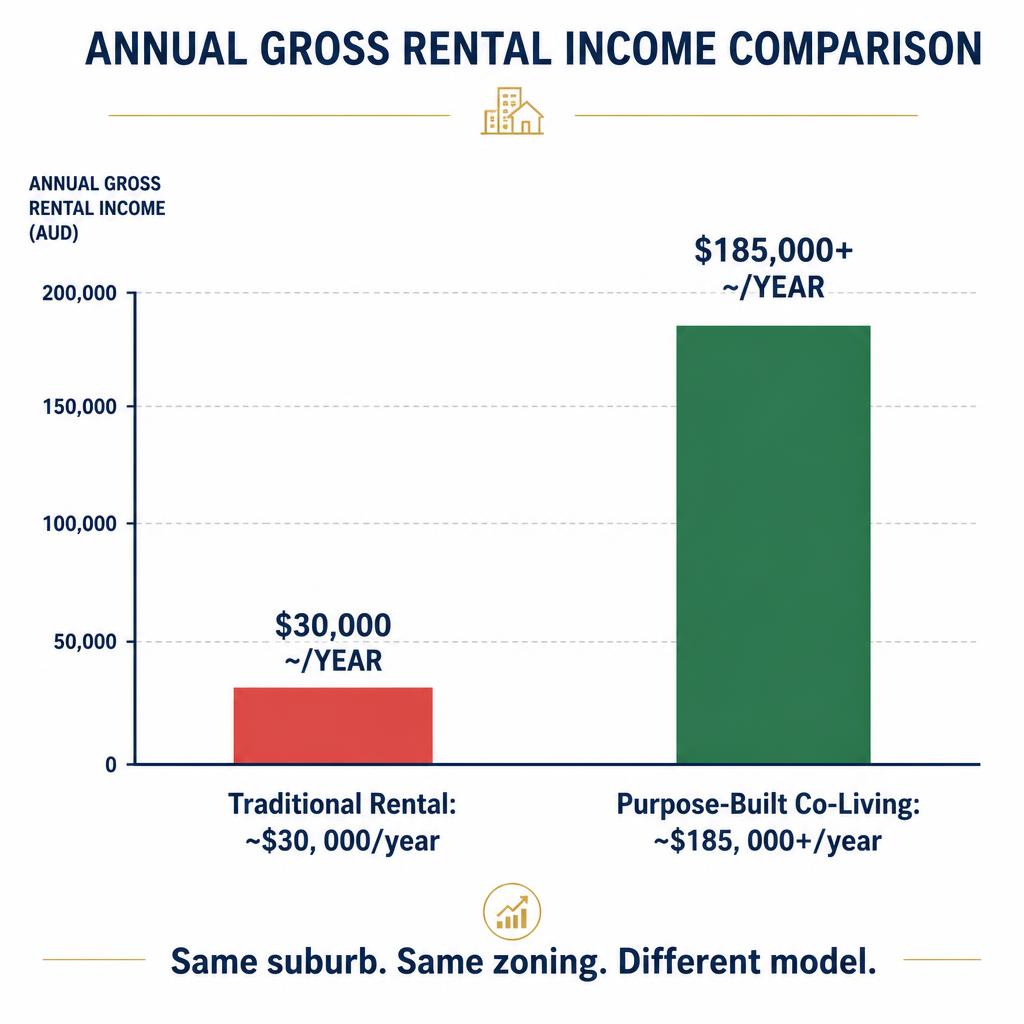
An asset generating $185,000 a year in gross income does not need negative gearing to produce a strong after-tax return. The depreciation deductions that drive the tax position are a function of new construction, not of rental losses. And the yield is high enough that the investment case stands on cash flow alone, regardless of what happens to capital gains tax settings.
This is not a theoretical argument. It is the reason the headline of this article has not changed since it was first drafted: negative gearing is dying, and our investors never needed it.
When the tax system rewarded speculation on existing housing, conventional investors had the advantage.
Now that it rewards new supply and income-producing assets, the advantage has shifted permanently to purpose-built co-living.
Part 5: What Happens Next
The budget measures are government policy but have not yet been legislated. They will require passage through both houses of Parliament, and consultation on the detailed design is expected over the coming months. The government holds a majority in the House of Representatives but will need crossbench or opposition support in the Senate.
However, the political dynamics strongly favour passage. The Greens have advocated for negative gearing reform for years and proposed even more aggressive changes at the 2025 election. The government’s version, with grandfathering for existing investors and carve-outs for new builds, is more moderate than the Greens’ position, making crossbench support probable.
For investors, the strategic implications are clear. The grandfathering provisions protect existing investments. But for new capital deployment, the tax environment has fundamentally changed. Established residential property is now structurally less attractive. New builds that add to the housing supply are structurally more attractive. And purpose-built co-living, which combines new-build status with double-digit gross yields, full depreciation entitlements, and preferential CGT treatment, sits at the intersection of every incentive the reformed system is designed to reward.
What This Means for You
The 2026 Federal Budget has confirmed the most significant restructuring of property investment tax settings in decades. For investors in conventional residential property, holding existing houses and units at thin yields, historically reliant on negative gearing to subsidise holding costs and capital growth to generate returns, these changes are a material threat to the investment model.
For investors in purpose-built co-living, the confirmed reforms do not diminish the investment case. They strengthen it. The new-build status preserves negative gearing entitlements. The CGT treatment is preferential, with a choice of discount method unavailable to any other asset class. Depreciation advantages are entirely outside the scope of any change. And the income-first return profile means the investment case has never depended on either negative gearing or CGT discounts to be compelling.
The market will take time to absorb the full implications. CBA forecasts house prices growing approximately 3 per cent less than they otherwise would have. Treasury modelling projects 75,000 additional owner-occupiers entering the market over the next decade, with approximately 35,000 fewer dwellings. The investors who are positioned in purpose-built co-living before the market fully prices in this structural shift will be on the right side of a once-in-a-generation rebalancing of Australian property investment.
The tax reforms that are reshaping conventional property investment are not a threat to this model. They are a structural tailwind.
Purpose-built co-living offers what the reformed tax environment rewards: income over speculation, new construction over existing stock, real yield over hoped-for capital gains. The investors who understand this structural difference are positioning now.
EME Rooming Houses specialises in the design, delivery, and asset management of purpose-built co-living properties in Victoria. Our Income Accelerator model allows investors to participate in Victoria’s most compelling residential yield story, without managing the development process themselves.
Disclaimer: This article is general information only and does not constitute financial, tax, or legal advice. The budget measures described are announced government policy pending legislation. Certain classifications, including the treatment of knock-down rebuild projects under the new build definition, will depend on the final form of the legislation. The analysis in this article reflects our interpretation of the announced policy as of the date of publication. Specific impacts will depend on individual circumstances, entity structures, and the final form of the legislation. Investors should seek independent professional advice from a qualified financial adviser, accountant, or tax agent before making any investment decision. EME Rooming Houses Pty Ltd is not a licensed financial adviser.