

The New Asset Class: How Investors Are Achieving 2–3x Rental Yields in Australia | EME Rooming Houses
The New Asset Class
How Sophisticated Investors
Are Achieving 2–3x Rental Yields
in Australia
Why Victoria’s housing crisis is creating a once-in-a-generation
opportunity for investors who understand the structural shift
The Uncomfortable Truth About Property Investment in Australia
Here is a fact that the property industry does not want you to think about too carefully: the average gross rental yield on a residential investment property in Australia is 4.69 per cent. After land tax, insurance, maintenance, management fees, vacancy periods, and the relentless upward creep of compliance costs, many investors are lucky to net 2 per cent. Some are going backwards.
Meanwhile, a purpose-built co-living home in metropolitan Melbourne can generate gross rental income exceeding $185,000 per year from a single residential site. A traditional rental on the same street might return $30,000. That is not a marginal improvement. It is a fundamentally different asset class operating under the same zoning laws, on the same land, in the same suburbs.
Yet the overwhelming majority of Australian property investors continue to deploy capital into a model that was designed for a demographic reality that no longer exists. They buy three-bedroom houses for families in a country where 61 per cent of households consist of just one or two people. They chase capital growth in markets where yields have compressed to the point of irrelevance. And they do this while the Victorian government systematically increases the cost of holding investment property, driving thousands of landlords out of the market entirely.
The question is not whether co-living is a viable asset class. The question is how long it takes sophisticated capital to recognise that traditional residential investment is structurally broken.
This report examines why the conventional approach to property investment in Australia is failing, what structural forces are creating a generational opportunity in purpose-built co-living, and why Victoria, paradoxically the state most hostile to traditional landlords, has become the most compelling market for this new asset class.
Part 1: The Broken Model
Australia Is Building the Wrong Homes for the Wrong People

Cotality, formerly CoreLogic, released landmark research in August 2025 that confirmed what demographers had been warning about for years. Eliza Owen, the firm’s Head of Research, described it plainly: there is a stark mismatch between who lives in Australian homes and the kinds of homes we are building.
The numbers are difficult to ignore. According to the Australian Bureau of Statistics, only around 30 per cent of Australian households are families with dependent children. By contrast, 31 per cent are couples without children. And 27 per cent are people living alone. That means 61 per cent of all Australian households are made up of just one or two people.
Yet 42 per cent of the national housing stock consists of three-bedroom dwellings. Studio and one-bedroom homes, the type that would actually suit more than a quarter of all households, account for just 6 per cent. At the 2021 Census, there were more two-person households living in three-bedroom homes (approximately 1.3 million) than there were three or four-person households in dwellings of that size (around 1.1 million).
We are not just under-building. We are misbuilding. And the market has not corrected because the financial incentives continue to point in the wrong direction.
Cotality’s data shows that four-bedroom homes delivered the strongest annualised capital growth nationally over the past five years at 8.7 per cent, compared to just 3.7 per cent for studio and one-bedroom dwellings. Investors rationally pursue larger homes because they appreciate faster. But in doing so, they contribute to a system that produces housing stock fundamentally mismatched with actual household needs. The result is structural inefficiency at a national scale, inflated purchase prices for the wrong type of dwelling, and a growing cohort of renters who cannot find housing that matches their circumstances.
Victoria’s Investor Exodus: A Crisis Manufactured by Policy

If Australia’s housing stock mismatch is a slow-moving structural problem, Victoria’s policy environment has turned it into an acute crisis. Since January 2024, the Victorian government has waged what many investors describe as open warfare on property holders.
The centrepiece was the dramatic reduction in the land tax threshold, from $300,000 to just $50,000, with steeper marginal rates applied progressively. For an investor holding a Brunswick townhouse with a site value of $400,000 and a Tarneit house at $250,000, the combined annual land tax bill now sits at approximately $2,975 under the 2026 rates, on top of all other holding costs. For investors holding property in trusts, the surcharge compounds further. Foreign owners face an additional 4 per cent absentee owner surcharge.
From January 2026, new rules prevent vendors from passing land tax costs to buyers in contracts under $10.7 million, meaning sellers bear the full annual liability regardless of when settlement occurs. The Vacant Residential Land Tax has been expanded statewide. A 7.5 per cent short-stay levy now applies to all stays under 28 days. And the State Revenue Office is actively using digital data-matching tools to identify properties that may not be correctly disclosed.
The impact has been measurable and severe. According to the Property Investment Professionals of Australia, 16.7 per cent of investors sold at least one property in 2025, up from 14.1 per cent in 2024 and 12.1 per cent in 2023. Ray White data shows hundreds of investment properties auctioned across Melbourne’s northern suburbs since the latest tax hikes took effect. Over 24,000 rental properties were withdrawn from the Victorian market during the 2023-24 financial year alone.
Victoria has created a paradox: the state with the greatest rental housing need is now the state where it is most expensive and most difficult to be a landlord. But within that paradox lies an opportunity that most investors have completely missed.
Part 2: The Structural Opportunity
Co-Living: Not a Trend. A Correction.
The concept of co-living is not new. What is new is the convergence of demographic, economic, and regulatory forces that have turned it from a niche housing model into a structural solution to a systemic problem.
Consider the demand fundamentals in Victoria alone. One in four Victorians now lives alone, and single-person households have grown approximately 20 per cent in five years. Yet only 0.05 per cent of all Victorian properties are classified as rooming houses. The gap between who needs housing and what housing exists is not narrowing. It is widening, rapidly.
Melbourne’s rental vacancy rate remains well below 2.5 per cent, the threshold considered balanced. National rents have surged 42.9 per cent over the past five years, adding roughly $204 per week to the median rental value. Over 55,000 households remain on Victoria’s social housing waiting list. And while the RBA raised rates to 3.85 per cent in February 2026, putting further pressure on housing affordability, the underlying supply deficit continues to deepen.
Purpose-built co-living directly addresses this structural mismatch. Instead of one tenancy generating one income stream from an oversized dwelling, a well-designed co-living home creates nine separate tenancies under one roof, each with individual lease agreements, in a building specifically designed for the single-occupancy, professional, and essential-worker demographics that represent the fastest-growing segment of housing demand.
The Yield Comparison: Traditional vs. Co-Living
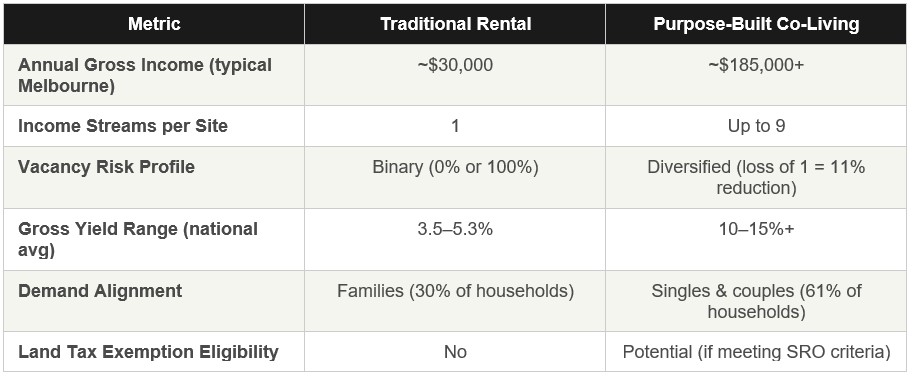

The yield differential is not incremental. It is transformational. And critically, the co-living model does not simply generate higher gross income. It fundamentally changes the risk profile of the investment. When a traditional rental property is vacant, the investor’s income drops to zero. When one room in a nine-tenancy co-living home turns over, the investor loses approximately 11 per cent of income while the remaining eight tenancies continue generating returns. This is not just higher yield. It is structurally more resilient yield.
Why Victoria, Specifically, Is the Best Market
It seems counterintuitive. Victoria is the state that has most aggressively increased costs for property investors. The Property Investment Professionals of Australia rated it the worst state for investors in Australia. Landlords are leaving in record numbers. How could it simultaneously be the most compelling market for co-living development?
The answer lies in the intersection of four factors that do not exist in this combination anywhere else in Australia.
First, Victoria’s regulatory framework for rooming houses is the most established in the country.
The Residential Tenancies Act 1997 defines rooming houses clearly: a building where rooms are available for rent to four or more unrelated people. The Residential Tenancies (Rooming House Standards) Regulations 2023 set explicit minimum standards for privacy, safety, amenity, and structural compliance. The licensing and registration frameworks through Consumer Affairs Victoria and local councils are well-documented and navigable. This is not a grey area. It is a defined, regulated asset class with clear compliance pathways.
Second, Melbourne’s property prices create a yield advantage that other capitals cannot match.
Melbourne units recorded the highest rental yields among major capitals at 8.3 per cent in the CBD, partly because Melbourne’s unit prices remain lower than Brisbane and Sydney. When you layer co-living economics on top of already-favourable yield dynamics, the returns become exceptional relative to capital deployed.
Third, the investor exodus is creating discounted acquisition opportunities.
As thousands of traditional landlords sell under the pressure of higher land taxes and compliance costs, well-located properties are hitting the market at prices that reflect seller distress rather than underlying asset value. For operators with the capability to convert or develop these sites into compliant, income-producing co-living assets, this represents a window of acquisition economics that may not persist.
Fourth, rooming houses in Victoria may qualify for land tax exemptions.
The State Revenue Office provides a specific land tax exemption pathway for rooming houses that meet defined criteria, including being registered with the local council and charging rents below prescribed thresholds. In a state where land tax is the single largest deterrent for investors, a legitimate pathway to exemption is a material competitive advantage.
Part 3: Why Most Co-Living Operators Will Fail
Here is the part that the co-living marketing industry does not tell you.
The opportunity is real. The demand is structural. The yield economics are genuine. But the delivery landscape is littered with operators who should never have entered the space, and with investors who will lose money because they chose the wrong partner.
The Australian co-living and rooming house development sector, as it exists today, is dominated by two types of operators. Neither is equipped to deliver what sophisticated capital requires.
The Marketing-Led Operators
These are the firms that sell the dream of passive income and high yields through polished renders, optimistic projections, and sophisticated sales funnels. Their websites are excellent. Their Instagram presence is carefully curated. Their seminars are well-attended. And their construction delivery credentials are, in many cases, thin to non-existent.
They operate on a simple model: generate leads, sell a development package, collect fees, and outsource the actual building to whoever is cheapest and available. The investor bears the delivery risk. When costs overrun, timelines blow out, or the finished product does not match the render, there is no governance framework, no risk register, and no accountable project director standing between the investor’s capital and the builder’s next variation claim.
A $1.5 million project with a 15 per cent cost overrun is a $225,000 loss. That is not a rounding error. That is the difference between a profitable investment and a financial disaster. And in small-scale development, where margins are tight and contingency budgets are often inadequate, a 15 per cent overrun is not unusual. It is common.
The Design-Led Firms
The second category comprises planning and design firms that specialise in rooming house approvals. Their value proposition is legitimate but limited: they know how to get a permit. What they do not do is procure builders, manage construction, control costs, structure capital, set up operations, or deliver a tenanted asset.
The investor who engages a design firm for approvals still needs to independently source a builder, negotiate a contract, manage the construction process, deal with variations and defects, establish a tenanting strategy, implement management systems, and navigate ongoing compliance. Each handoff between providers creates a gap where cost, time, and quality are lost. The design firm blames the builder. The builder blames the design. And the investor is left in the middle with a half-finished or non-compliant asset and no single point of accountability.
The uncomfortable truth is this: co-living is a construction-led asset class being marketed by sales-led and design-led operators. And that mismatch between what is being sold and what is actually required for successful delivery is where investor capital is at greatest risk.
Part 4: What Institutional-Grade Delivery Looks Like
If the opportunity is structural and the risks are primarily in delivery, then the question for any sophisticated investor is straightforward: what does a properly governed, construction-led delivery model look like in this sector?
It looks like taking the same project management discipline, cost control frameworks, risk registers, milestone tracking, and governance reporting used on $60 million shopping centre redevelopments, $20 million university research facilities, and national retail construction programs, and applying them, without compromise, to every co-living development regardless of its size.
Because the principles do not change with the dollar value. A project is either governed or it is not. Risks are either identified and mitigated or they are not. Costs are either controlled against a defined budget with transparent variation management, or they are not. The fact that a co-living project might cost $1.5 million instead of $60 million does not make governance optional. If anything, it makes governance more critical because smaller projects have proportionally less margin for error.
The EME Method™: A Framework Built From 30 Years of Institutional Delivery
EME Rooming was founded on a specific thesis: that the co-living sector’s greatest unmet need is not better marketing, better design, or better sales. It is better delivery. Specifically, construction-grade project delivery with the governance, reporting, and risk management that institutional capital expects as a baseline, not a premium add-on.
The company is led by Georgia Hartin, whose career spans more than 30 years and over $350 million in completed construction across five sectors: retail, education, government, commercial, and residential. Her track record includes delivering projects for Lend Lease, Vicinity Centres, La Trobe University, Monash University, and Woolworths Group. She has managed $64 million coronial services centres, $60 million shopping centre redevelopments, $20 million university research facilities, national school building programs, and entire state-wide retail construction portfolios.
This is not a profile you find anywhere else in the Australian co-living sector. And it is the foundation of what EME calls the EME Method™, a proprietary delivery framework built from actual institutional process, not marketing theory.
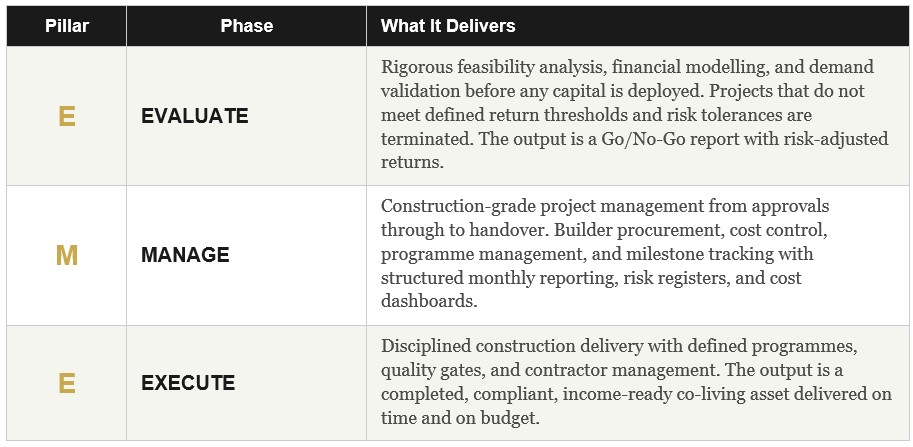

The EME Method is not a marketing construct. It is a codification of how Georgia Hartin has delivered projects for three decades. E-M-E maps directly to the brand name, not because the acronym was reverse-engineered, but because evaluate, manage, and execute is genuinely how every project runs from first site visit to final tenant placement.
Part 5: The Investment Thesis
Why This Matters Now, Not Later
The structural forces driving this opportunity are not cyclical. They are permanent. Australia’s household composition has fundamentally shifted. The ABS projects that lone-person and couple-without-children households will continue to grow as the dominant share of all households through at least 2046. Housing stock cannot be unbuilt and rebuilt to match. The mismatch between what exists and what is needed will persist for decades.
Victoria’s rental supply crisis is accelerating, not stabilising. National rental listings in the fourth quarter of 2025 were approximately 11 per cent lower than a year prior and 17 per cent below the five-year average. The national vacancy rate stood at 1.7 per cent, well below the 2.5 per cent threshold considered balanced. KPMG projected in January 2026 that new dwelling completions would need to be approximately 17 per cent higher than current forecasts simply to return rental growth to normal levels while accommodating expected population growth.
And the regulatory environment, while hostile to traditional landlords, is structurally supportive of the co-living model. Victoria’s rooming house framework provides defined compliance pathways, potential land tax exemptions, and a level of regulatory certainty that does not exist for co-living in most other Australian states. The very policies that are driving traditional investors out of Victoria are creating the conditions in which purpose-built co-living can thrive.
Three Partnership Models for Different Capital Profiles
EME Rooming has structured three partnership models, each designed for a different capital profile, risk appetite, and level of involvement.
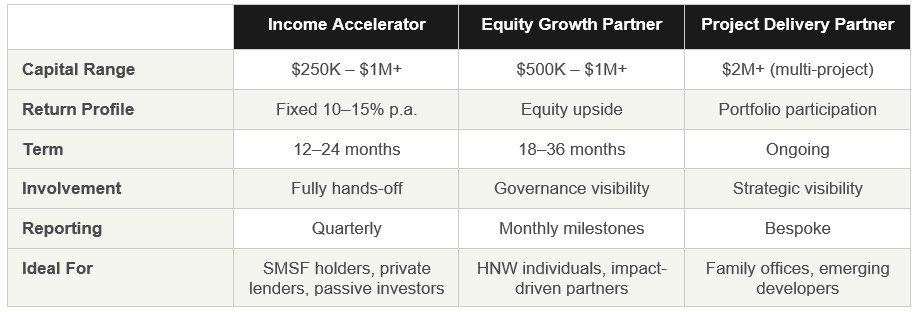
Each model is underpinned by the same institutional delivery framework. The difference lies in how capital is structured, how returns are generated, and the level of governance participation the partner prefers. In every case, EME retains end-to-end accountability for the delivery process from feasibility through to a tenanted, operational asset.
Conclusion: The Contrarian Case
The consensus view in Australian property is that Victoria is a market to avoid. Investors are leaving. Land tax is punitive. Rental regulations are onerous. The narrative is one of retreat.
But consensus views, by definition, are already priced in. When every traditional landlord is selling and every property commentary is negative, the question a sophisticated investor should ask is not “should I follow the crowd out?” but “what is the crowd missing?”
What the crowd is missing is this: Victoria’s housing crisis is not a temporary dislocation. It is a structural transformation. The state has more single-person households than it can house, less rental stock than it had a year ago, a regulatory framework that specifically accommodates and potentially incentivises co-living, and a property market where distressed sellers are creating acquisition opportunities that have not existed in a generation.
The traditional model of buying a three-bedroom house, placing a single tenancy, and waiting for capital growth was designed for a different Australia. That Australia is gone. What has replaced it is a country where 61 per cent of households are one or two people, where rents have surged nearly 43 per cent in five years, and where the housing people actually need does not exist in anywhere near sufficient quantity.
Co-living is not an alternative investment strategy. It is the logical response to the reality of how Australians actually live, rent, and form households in 2026. The only question is whether you position your capital on the right side of that reality before the rest of the market catches up.
IMPORTANT NOTICE
This report is published by EME Rooming for informational purposes only and does not constitute financial, investment, legal, or tax advice. The Information contained herein is based on publicly available data and sources believed to be reliable, but no representation or warranty is made as to its accuracy, completeness, or timeliness. Past performance is not indicative of future results. All investment involves risk, including the potential loss of capital. Projected returns are illustrative and not guaranteed. Prospective investors should conduct their own independent due diligence and seek advice from qualified financial, legal, and tax professionals before making any investment decision. EME Rooming and its officers, employees, and affiliates accept no liability for any loss or damage arising from the use of this report.
© 2026 EME Rooming. All rights reserved. This document may not be reproduced, distributed, or transmitted without prior written consent.
SOURCES & REFERENCES
Australian Bureau of Statistics – Household and Family Projections, Australia 2021–2046
Cotality (formerly CoreLogic) – “The Great Mismatch: Smaller Households, Bigger Homes”, August 2025
Global Property Guide – Australian Rental Yields Q1 2026
Property Investment Professionals of Australia (PIPA) – Annual Property Investor Sentiment Survey 2025
Ray White – Victorian Investment Property Auction Data, 2024–2026
State Revenue Office Victoria – Land Tax Rates 2026, VRLT Guidelines, Rooming House Exemption Criteria
KPMG Australia – Residential Property Market Outlook, January 2026
Reserve Bank of Australia – Statement on Monetary Policy, February 2026
Consumer Affairs Victoria – Rooming House Standards and Operator Licensing
Residential Tenancies (Rooming House Standards) Regulations 2023 (Vic)
Cushman & Wakefield – “Rebalancing Australia’s Housing Mismatch”, March 2026
Australian Institute of Health and Welfare – Housing Affordability Report 2024–25